


Photo by WikimediaCommons
The question of why the 1950s economy changed American family life has a clear answer: money, jobs, and housing all shifted in powerful ways.
After World War II ended, soldiers came home ready to settle down. and the government passed the G.I. Bill to help returning veterans buy homes and attend college. Despite the many benefits, this law did not help everyone equally, especially Black veterans.
Still, for many white families, it created a path toward the suburbs and a middle-class life.
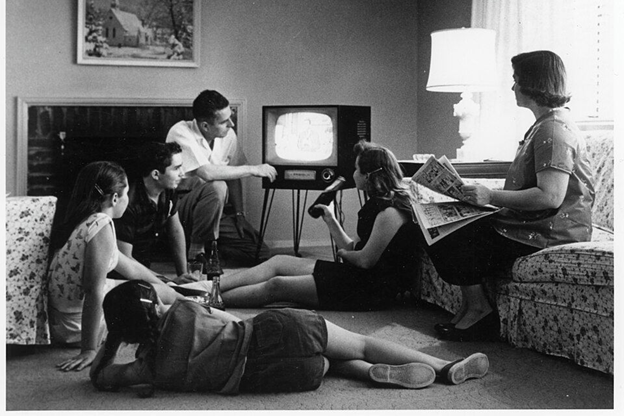
The American family soon moved away from crowded city apartments into brand-new tract homes in places like Levittown, where homes were small but affordable, and a new kind of US household dynamics was born: the father working in a factory or an office, and the mother staying home to raise the children.
This setup became the gold standard for the American family in the fifties. But this picture was not the whole truth: many families still struggled, and many others were left out completely.
Still, the economic boom of the fifties locked in a new model for the American family that would last for decades.
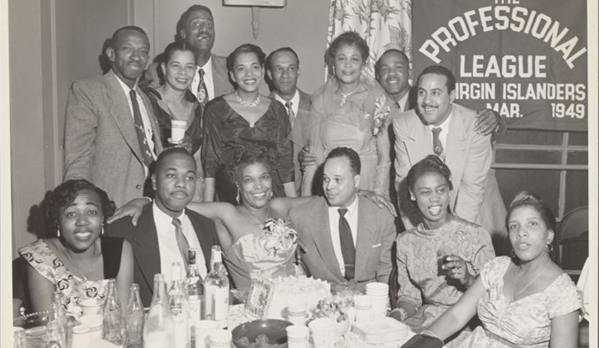
Photo by NYPublicLibrary
The Postwar Boom and US Household Dynamics
When the war ended, and the world finally began to rebuild, factories ran at full speed after the war, workers earned better wages and joined labor unions, which pushed for higher pay, safer conditions, and health benefits.
For the American family, this meant more money in the paycheck: a man could support a wife and several children on a single income.
That was a massive shift from the days of the Great Depression, when everyone struggled to find work, and the future seemed utterly bleak. Consumer spending was exploding, with families buying washing machines, televisions, and cars on credit.
This created a cycle: work hard, buy more, and keep up with the neighbors. The adults of the ’50s had grown up in general poverty during the Great Depression and endured rationing during World War II, writes Dennis Joiner in The Turn.
Now they wanted comfort, resulting in the American family becoming a buying machine, with suburbs spreading out around cities, and every house needing a car. Drive-through restaurants, banks, and even churches appeared.
This new way of living changed American domestic life forever, with the nuclear and extended families that once lived close together now spread apart across counties and states.
US household dynamics became more isolated but also more private.
How Nuclear & Extended Families Shifted
Before the fifties, many American families lived in multigenerational homes: grandparents, aunts, uncles, and cousins often shared space or lived nearby.
The postwar boom changed all of that.
Young couples wanted their own houses in the suburbs; so, they left older relatives behind in the cities. This shift weakened the extended family structure, and the nuclear family—just a mom, dad, and kids—became the ideal.
The monogamous nuclear family had been recognized as a crucial element to ensure the livingry needs and the psychosocial wellbeing of children, Joiner explains.
But this setup also brought new pressures.
The father was working long hours now and was often absent while the mother managed the home alone, without the help of nearby relatives.
American domestic life became more private, yes, but also lonelier due to an increasing focus on household prosperity rather than community.
Many women felt trapped inside these arrangements. Books like The Feminine Mystique later exposed this hidden unhappiness. Still, the nuclear family model spread fast, with schools, churches, and TV shows all promoting it. This model worked well for the economy, because each nuclear family needed its own house, car, appliances, and furniture.
Consumer spending kept the boom going, but the shift away from extended families also weakened American kinship patterns, making them more fragile.
Modern Family Structures Emerging from Economic Change
The economic changes of the fifties did not create just one kind of American family. For white middle-class families, the suburban nuclear model worked well, but for Black families and other minority groups, the picture looked very different.
The G.I. Bill primarily provided loans to white veterans, as redlining kept Black families out of many suburbs, and jobs with good wages often went tong to white men first. And so while white families built wealth through homeownership, Black families stayed in crowded cities with fewer opportunities. Black Americans faced discrimination when trying to claim their benefits, Joiner notes about the G.I. Bill. The boards that determined who would or wouldn’t receive them consisted of white men.
This unequal start helped create two very different versions of American domestic life: white families moved to the suburbs, and Black families remained in cities that lost tax money and services. This split would shape modern family structures for generations, with single-parent households becoming more common in poor urban areas while two-parent breadwinner homes stayed the norm in white suburbs.
The fifties did not create these differences from scratch, but they made them much worse, and by the end of the decade, the seeds of later family diversity had already been planted.
The American family was no longer one thing and was becoming many things, for better and worse.
The Hidden Costs of Prosperity on Domestic Life
The fifties gave the American family new comforts but also new stresses: men were working long hours at jobs that often bored them, and women stayed home with children but felt cut off from adult conversation and purpose. Teenagers had more money from part-time jobs and wanted their own music, clothes, and fun.
The generation gap appeared starkly for the first time.
Children—mainly because of rock’n’roll music, which reflected their desire to rebel against adult authority—were different than their parents, Joiner writes.
The American family began to crack from within, as divorce rates stayed low in the fifties, while unhappiness grew beneath the surface. Many wives took tranquilizers to get through the day, and husbands drank too much, as kids acted out.
The economy encouraged a certain kind of American family, but it could not make that family happy. Money could buy houses and cars, but not peace. The pressure to conform—to look perfect on the outside—made many people miserable on the inside.

Photo by freepik
Want to understand how the American family kept changing through the 1960s, 70s, and up to today?
Dennis Joiner’s book The Turn pulls back the curtain on 75 years of social and economic shifts that reshaped US household dynamics.


0 Comments