


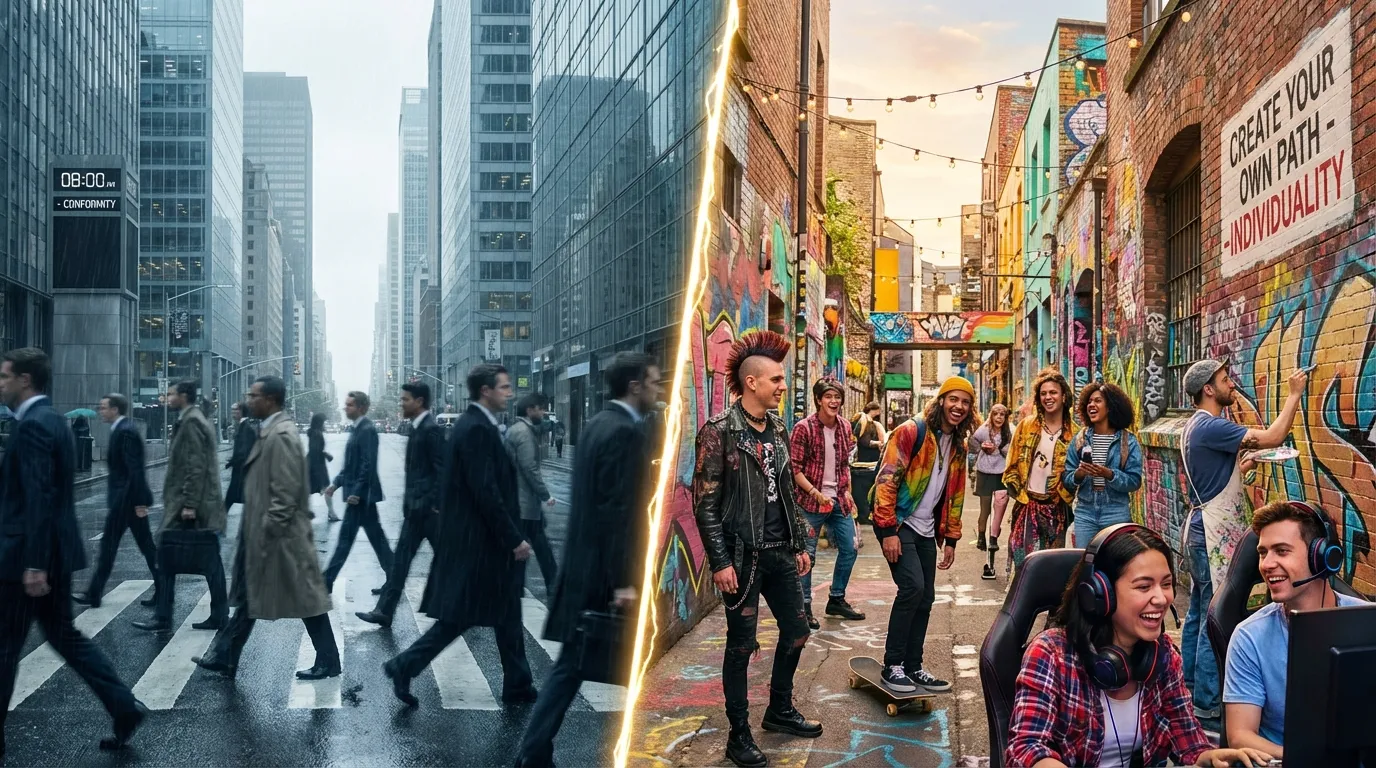
Most people think culture is something big.
A country. A tradition. Shared way of life.
But culture is not just one thing. It breaks into smaller pieces. Quiet groups. Loud movements. People who follow the system. People who question it. And people who walk away from it completely.
That is where subculture and counterculture come in.
These are not just sociology terms. They explain real behavior. Why do people dress a certain way? Why do they believe what they believe? And why do some feel at home in society, while others feel out of place?
If you have ever felt like you didn’t fully belong, you were already brushing against these ideas.
Culture Is the Starting Point
To understand anything else, start here.
Culture is the shared system of meaning:
- what people believe
- how they behave
- what they accept as normal
It shapes daily life without people noticing.
But no culture fits everyone perfectly.
That gap creates space.
And in that space, groups begin to form.
What Is a Subculture?
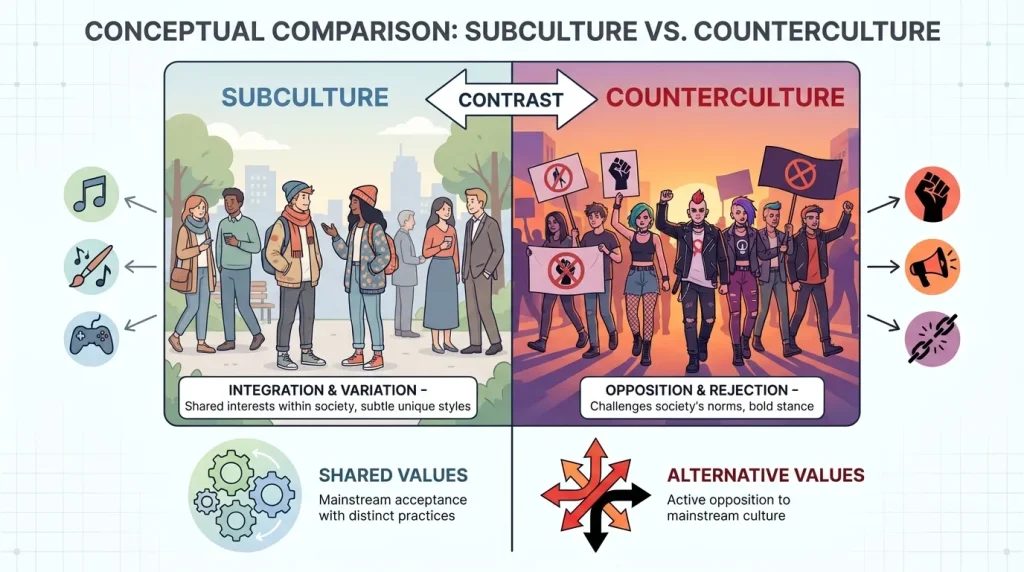
A subculture is a group that lives inside the larger culture but builds its own identity.
It does not reject society. It simply interprets it differently.
What Makes a Subculture:
- Shared interests or lifestyle
- Distinct language, style, or habits
- Long-term identity, not temporary
Unlike short-term groups (like a class or office team), a subculture becomes part of who someone is over time.
Examples You See Every Day:
- Gamers who share language, humor, and routines
- Fitness communities with discipline and routines
- Book lovers who value reflection and storytelling
- Car enthusiasts who bond over mechanics and design
They are not trying to fight society.
They are simply carving out their own space within it.
What Is a Counterculture?
A counterculture takes a stronger position.
It does not just differ.
Disagrees at a deep level.
It challenges what society believes is right, normal, or acceptable.
What Defines a Counterculture:
- Strong value conflict
- Rejection of major norms
- Desire for change or resistance
This is not about style.
It is about belief.
The Real Difference (Without Confusion)
Most people get stuck here. So let’s simplify it clearly.
Subculture:
“We live differently.”
Counterculture:
“The system is wrong.”
That one shift changes everything.
Why Do These Groups Exist?
This is the part most articles skip.
People do not randomly fall into these groups.
They are driven by human needs.
1. The Need to Belong
People want to feel seen and understood.
2. The Need for Identity
Groups give language to who someone is.
3. The Need for Meaning
Some feel that mainstream culture is shallow or confusing.
4. The Need for Control
When the world feels unclear, groups provide structure.
When people feel overwhelmed by mixed messages, confusion grows. Over time, this can shape how groups form and what they believe.
That is when subcultures deepen.
And when pressure builds enough, countercultures emerge.
The Emotional Side of Culture (What People Don’t Talk About)
Subcultures feel safe.
Countercultures feel urgent.
Subculture:
- Comfort
- Shared interest
- Belonging
Counterculture:
- Frustration
- Resistance
- Desire for change
This is why countercultures often appear during times of tension.
People are not just reacting to ideas.
They are reacting to how those ideas make them feel.
How Subcultures Grow Over Time
Subcultures do not stay static.
They evolve.
Phase 1: Formation
A small group forms around a shared interest or identity.
Phase 2: Expansion
More people join. Identity becomes clearer.
Phase 3: Recognition
Society begins to notice the group.
Phase 4: Integration or Conflict
- Some merge into mainstream (stay subculture)
- Others clash (become counterculture)
This is where things split.
When a Subculture Becomes a Counterculture
The shift happens when values stop aligning.
It is not about fashion anymore.
It is about belief.
Example Pattern:
- A group forms around a shared interest
- Members develop stronger opinions
- They begin to question the system
- They reject parts of it
- Conflict grows
Now it becomes a counterculture.
Case Study: Punk Culture (A Full Transformation)
Punk is one of the best examples because it shows change over time.
Early Punk (Counterculture)
- Loud rejection of authority
- Anti-system mindset
- Shock value appearance
- Music with anger and protest
It clearly opposed mainstream society.
Middle Phase
- People aged
- Responsibilities increased
- Expression became less extreme
Later Punk (Subculture)
- Values remained
- Style softened
- Identity became internal
Older members kept their beliefs but expressed them differently.
As observed, punk shifted from visible rebellion to internal identity and lifestyle.
This shows something important:
Not all rebellion stays loud. Sometimes it becomes quiet but lasting.
The Role of Media and Influence
Culture does not grow in isolation.
Media shapes it constantly.
- Television defines norms
- Social media spreads ideas faster
- Algorithms group people together
Over time, repeated messages influence how people think.
When people feel unsure about what is real or true, they look for groups that feel stable.
That is where subcultures strengthen.
When trust breaks down, countercultures rise.
The Cycle of Culture (A Simple Pattern)
Culture moves in cycles:
- Mainstream sets norms
- Subcultures form within it
- Some become countercultures
- Countercultures influence society
- New norms are created
Then it repeats.
What was once rebellious can become normal.
Modern Examples You Can Relate To
Today’s Subcultures:
- Digital creators
- Remote workers
- Minimalist lifestyles
- Wellness communities
They live differently but still function within society.
Today’s Countercultures:
- Anti-consumer groups
- Extreme political groups
- Radical lifestyle movements
They question systems like:
- work
- government
- economy
- social norms
The Risk of Misunderstanding
Not all groups are harmless.
Some can:
- spread false ideas
- isolate members
- create division
When people lose trust in shared truth, confusion grows.
That confusion can lead to stronger division.
Understanding culture helps prevent blind following.
How to Identify Subculture vs Counterculture (Simple Tool)
Use this quick check:
1. Does the group accept society’s core beliefs?
- Yes → Subculture
- No → Counterculture
2. Is the goal expression or change?
- Expression → Subculture
- Change → Counterculture
3. Is the difference surface-level or deep?
- Style → Subculture
- Values → Counterculture
A Deeper Reflection: Where Do You Fit?
Everyone belongs to something.
Even if you think you don’t.
Ask yourself:
- What influences how you think?
- What groups do you relate to?
- Do they support or challenge society?
You may find:
- You are part of multiple subcultures
- You agree with some counterculture ideas
- Your identity is shaped more than you realized
Why This Topic Matters Today
Today’s world is louder than ever.
More voices. More opinions, and more groups.
This makes:
- identity more complex
- belonging more important
- conflict more visible
Understanding subculture and counterculture helps you:
- think clearly
- avoid confusion
- understand people better
FAQs
1. Can someone belong to both a subculture and a counterculture?
Yes. People often move between groups or relate to both.
2. Do subcultures always stay small?
No. Many grow and influence mainstream culture.
3. What causes countercultures to form?
Strong disagreement with the core values of society.
4. Why do countercultures often seem aggressive?
Because they are driven by frustration and urgency.
5. Can countercultures become normal?
Yes. Many ideas once rejected are now accepted.
Final Thoughts
Culture is not fixed.
It shifts with people.
Some follow it. Some shape it, and some resist it.
Subculture and counterculture are not just about groups.
They are about how people respond to the world around them.
Understanding them helps you see deeper.
Not just society.
But yourself.
CTA
If this made you think differently, save this article and share it with someone who enjoys understanding people and behavior.
Or better yet, drop a comment:
What subculture do you feel part of right now?
If you want to explore how social change, conflict, and cultural shifts shape society on a deeper level, check out Dennis Joiner’s books on social transformation and cultural change.

0 Comments