


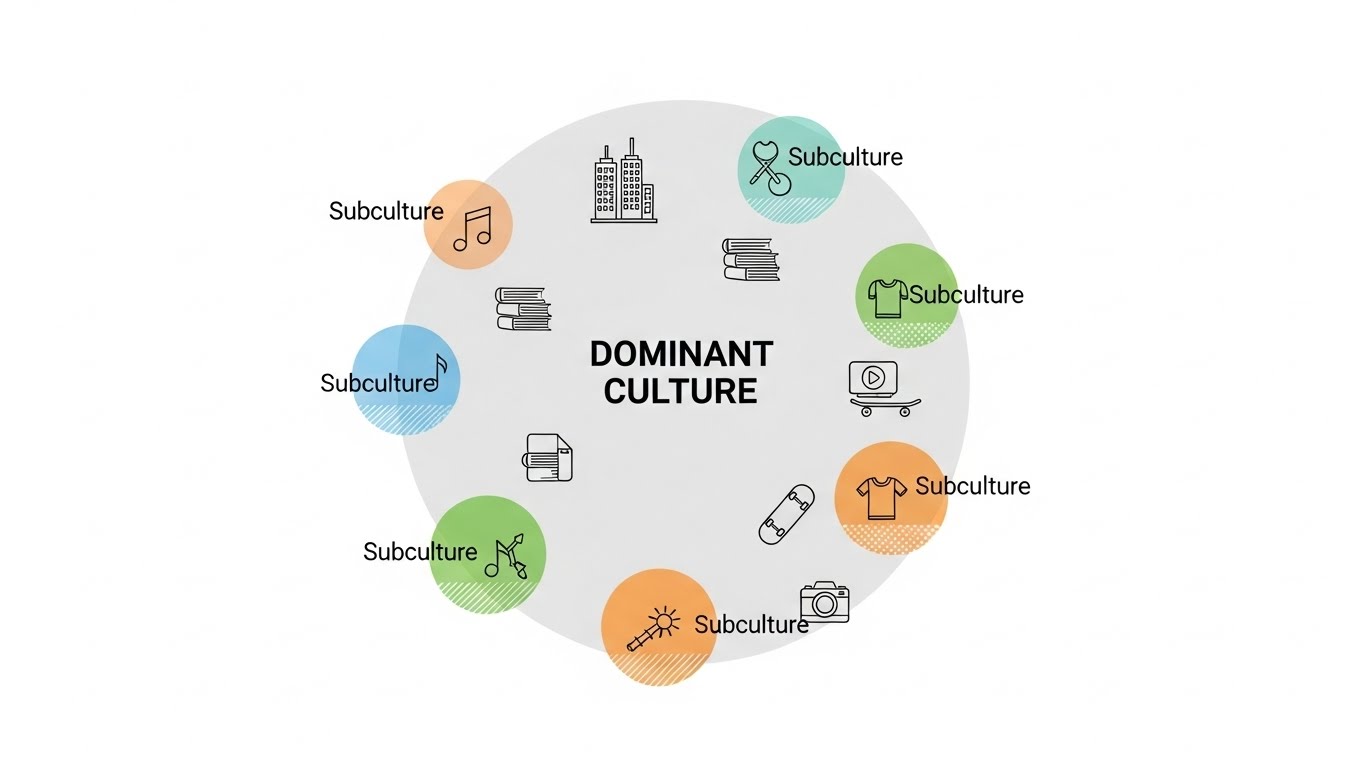
A teenager adopts the language, music, clothing, and unwritten rules of a local skateboarding community. At home, school, and work, that same person still follows the laws, schedules, and basic customs of the larger society. This overlap captures the relationship between a subculture and a dominant culture: one gives the person a distinct group identity, while the other supplies the wider social system in which that identity operates.
Differences should not be mistaken for total rejection. Most subcultures select, reinterpret, or intensify certain values while continuing to share many of the dominant culture’s institutions and expectations.
The Quick Takeaway: A subculture is a smaller cultural group that exists inside a dominant culture, sharing much of the larger society’s way of life while developing its own identity, norms, symbols, and practices. The relationship can involve peaceful coexistence, negotiation, unequal power, resistance, cultural exchange, or gradual absorption into the mainstream.
| Core question | Dominant culture | Subculture | How the two relate |
|---|---|---|---|
| Who belongs? | Broad population shaped by widely accepted institutions and practices | A smaller group linked by identity, interest, experience, belief, or style | Members usually participate in both |
| Which rules matter? | Defines widely recognized norms, language, laws, and conduct | Adds group-specific expectations, meanings, rituals, or slang | The subculture modifies part of the larger cultural script |
| Who has power? | Usually influences schools, media, law, business, and public reputation | Often has less authority to define what society calls normal | Power affects labeling, acceptance, policing, and visibility |
| How is identity expressed? | Through familiar civic, religious, economic, and family patterns | Through distinctive symbols, dress, music, spaces, stories, or behaviors | Difference creates belonging without always ending integration |
| What produces conflict? | Pressure for conformity, order, or shared standards | Desire for recognition, autonomy, reform, or protection | Conflict grows when distinct practices challenge major mainstream values |
| How does change occur? | Adopts, regulates, commercializes, or resists new practices | Introduces new language, art, habits, viewpoints, and demands | Repeated contact can change both groups |
This comparison follows the standard sociological distinction between a dominant culture, subcultures within it, and countercultures that oppose central cultural patterns.
A Subculture Belongs to the Larger Society While Creating a Distinct Social Identity
To explain the relationship between a subculture and a dominant culture, begin with cultural nesting. A subculture is inside the larger culture rather than fully outside it. OpenStax describes subcultures as smaller groups within society and distinguishes them from countercultures, which directly reject major patterns of the dominant culture. OpenStax’s sociology overview provides a useful academic foundation.
Consider a workplace subculture among emergency-room nurses. Members may share dark humor, rapid shorthand, strong mutual trust, and informal rules that outsiders do not understand. Yet they still follow hospital policies, professional standards, national laws, and ordinary civic expectations. Their subculture helps them function within the dominant system.
The same pattern appears in Dennis Joiner’s The Turn, which examines beatniks, hippies, protest movements, cultural conflict, and the movement of fringe ideas into mainstream American life. Its discussion of the Beat Generation presents a group that rejected materialism and conventional expectations while remaining connected to American literature, cities, politics, and public debate.
The Dominant Culture Has Greater Power to Define What Society Treats as Normal
Size alone does not make a culture dominant. Institutional power does. The dominant culture usually has greater influence over education, law, employment, media representation, public language, and access to resources. Its customs may appear neutral or universal, while a subculture’s customs are marked as unusual, improper, fashionable, threatening, or exotic.
Imagine a school in which one style of speech is treated as professional and another as careless, even when both communicate clearly. The distinction may reflect cultural authority rather than linguistic ability. This is one reason social conditioning shapes behavior and judgment: people learn which accents, clothes, family patterns, and beliefs receive approval before they consciously examine those standards.
Power also shapes labels. A dominant group can describe a youth scene as delinquent, a religious community as isolated, or an artistic movement as vulgar. Subculture members may answer by reclaiming the label or creating their own media. Britannica notes that subcultures can flourish within a dominant framework and develop specialized language shaped by relations within the group and with outsiders.
Subcultures Can Coexist, Adapt, Resist, or Become Countercultures
The first pattern is coexistence. A group keeps its distinctive customs while accepting most of the larger society’s rules. Religious communities, occupational groups, regional cultures, and music scenes often operate this way. In Pew Research Center’s 2017 survey, 92 percent of Muslim American respondents were proud to be American, while 97 percent were proud to be Muslim. The findings show how strong group and national identities can exist together.
A second pattern is adaptation or assimilation. Members may adopt dominant language, clothing, workplace behavior, or civic habits to gain access and reduce friction. Over time, the group can become less socially distinct. Britannica defines assimilation as absorption into a dominant culture until the group becomes socially difficult to distinguish from others.
The third pattern is resistance. A subculture becomes countercultural when it opposes central values or institutions and seeks serious change. Readers exploring the difference between subculture and counterculture should focus on the degree of opposition, not clothing or music alone. A punk scene may be a subculture if it offers shared style and community; it becomes countercultural when members organize against political authority, consumerism, or accepted social rules.
Cultural Exchange Can Move Ideas From the Margins Into the Mainstream
Subcultures often function as cultural laboratories. Members create new slang, music, fashion, art, technologies, and social practices on a smaller scale. The dominant culture may first mock or condemn these innovations, then adopt them after media exposure, commercial interest, generational change, or political pressure makes them familiar.
Hip-hop offers a clear example. Smithsonian coverage of hip-hop traces its Bronx origins and its growth into an international cultural force spanning music, dance, art, fashion, and storytelling. Mainstream institutions amplified hip-hop while also selecting, selling, and sometimes separating its style from its community meanings.
The 1960s counterculture followed another path. Opposition to conventional authority, war, restrictive social roles, and established moral expectations produced conflict, yet parts of the movement later influenced entertainment, environmental activism, fashion, and public debate. That process helps explain one effect the counterculture had on American life. Britannica’s historical overview describes the movement as a broad rejection of conventional mores and traditional authorities.
The Turn also treats the counterculture’s rise and decline as a major stage in America’s cultural shift. Its historical argument shows how opposition from smaller movements can provoke political reaction, alter public language, and leave lasting marks even after the original movement loses momentum.
The Relationship Changes Both the Subculture and the Dominant Culture
Mainstream adoption can give a subculture recognition, protection, income, and political influence. It can also weaken the intimacy that once held the group together. Once outsiders adopt the clothing, language, or music, original members may feel that their identity has been diluted or turned into a product.
The dominant culture changes as well. New words enter common speech, minority histories enter curricula, unfamiliar foods become ordinary, and marginal artistic forms reach national institutions. Such changes can broaden participation, but they can also trigger backlash from people who believe familiar standards are disappearing. The Turn treats this struggle over norms, authority, and social continuity as central to recent American cultural conflict.
Individual choice matters in this process. People decide which parts of the dominant culture to accept and which subcultural commitments to preserve. The discussion of individualism in American society adds another layer: personal freedom can encourage cultural experimentation, yet society still needs enough shared expectations to support cooperation.
How to Analyze the Relationship in a Real Group or Historical Movement
A reliable analysis should move beyond visible style. Clothing, music, or slang may signal membership, but they do not reveal the full relationship with the dominant culture. Study the group’s values, institutions, treatment by outsiders, access to power, and influence over time.
Use this six-step process:
- Define the dominant setting. Identify the society, institution, city, school, workplace, or historical period that establishes broad norms.
- List what the group shares with it. Note common language, laws, economic activity, education, citizenship, technology, or moral beliefs.
- Identify the subculture’s distinctive features. Look for special symbols, rituals, spaces, stories, language, dress, leadership, and rules.
- Measure the power difference. Ask who controls hiring, schooling, media images, lawmaking, funding, and public labels.
- Classify the interaction. Decide whether the group mainly coexists, adapts, resists, withdraws, negotiates, or influences the mainstream.
- Track change across time. Record which ideas disappear, remain separate, become products, gain legal protection, or enter common practice.
Apply the method to the Beat Generation. The dominant setting was postwar American society, with strong expectations involving family life, material success, patriotism, and conformity. Beat writers shared American language and literary institutions but developed distinctive artistic, spiritual, and social practices. Their influence later reached the hippie movement and wider culture, showing why subcultures and countercultures are related without being identical.
Why This Relationship Matters for Understanding Social Change
Subcultures reveal where a dominant culture fails to satisfy every member. A group may form around exclusion, shared work, artistic taste, faith, generation, neighborhood, political belief, or a need for belonging. Its existence tells researchers which voices and experiences remain weakly represented in mainstream institutions.
They also show how change begins before it becomes law or common opinion. New ideas are often tested in small communities, publications, artistic scenes, churches, clubs, campuses, or online networks. Some fail, some remain limited, and others alter national language and behavior. Cultural history, therefore, cannot be understood solely through presidents, courts, and major institutions.
For readers of The Turn, this relationship provides a practical lens for studying the last 75 years of American conflict. Beatniks, civil rights activists, hippies, religious movements, political factions, and media communities all interacted with dominant institutions in different ways. Literature can examine those pressures at the level of individual lives, which is why social commentary in literature remains valuable: stories show how public norms enter private choices, family tensions, loyalties, and fears.
Frequently Asked Questions
Can a person belong to a subculture and the dominant culture at the same time?
Yes. Most people hold several overlapping identities, such as national, professional, religious, regional, and recreational identities. A person can follow the larger society’s laws and institutions while using the language, rituals, and values of a smaller group.
Does every subculture oppose the dominant culture?
No. Many subcultures differ in limited areas while accepting most mainstream norms. Direct opposition becomes more likely when the group challenges central values, authority, or institutions, moving it closer to counterculture.
What causes conflict between a subculture and a dominant culture?
Conflict usually grows from unequal power, negative labeling, competition for resources, demands for recognition, or disagreement over core moral rules. Tension becomes sharper when the dominant culture suppresses the group or the subculture seeks to replace widely accepted standards.
How does a subculture become part of mainstream culture?
The shift can occur through media exposure, business investment, political organizing, generational replacement, legal recognition, or repeated contact. Mainstream adoption often changes the original practice, especially when institutions commercialize its visible style but ignore its history.
What is the simplest real-life example of this relationship?
A school sports team is a useful example. Players develop traditions, slang, status rules, and group loyalty, yet they remain part of the school and follow its academic and conduct policies. Their subculture creates a distinct identity within the dominant institutional culture.

0 Comments