


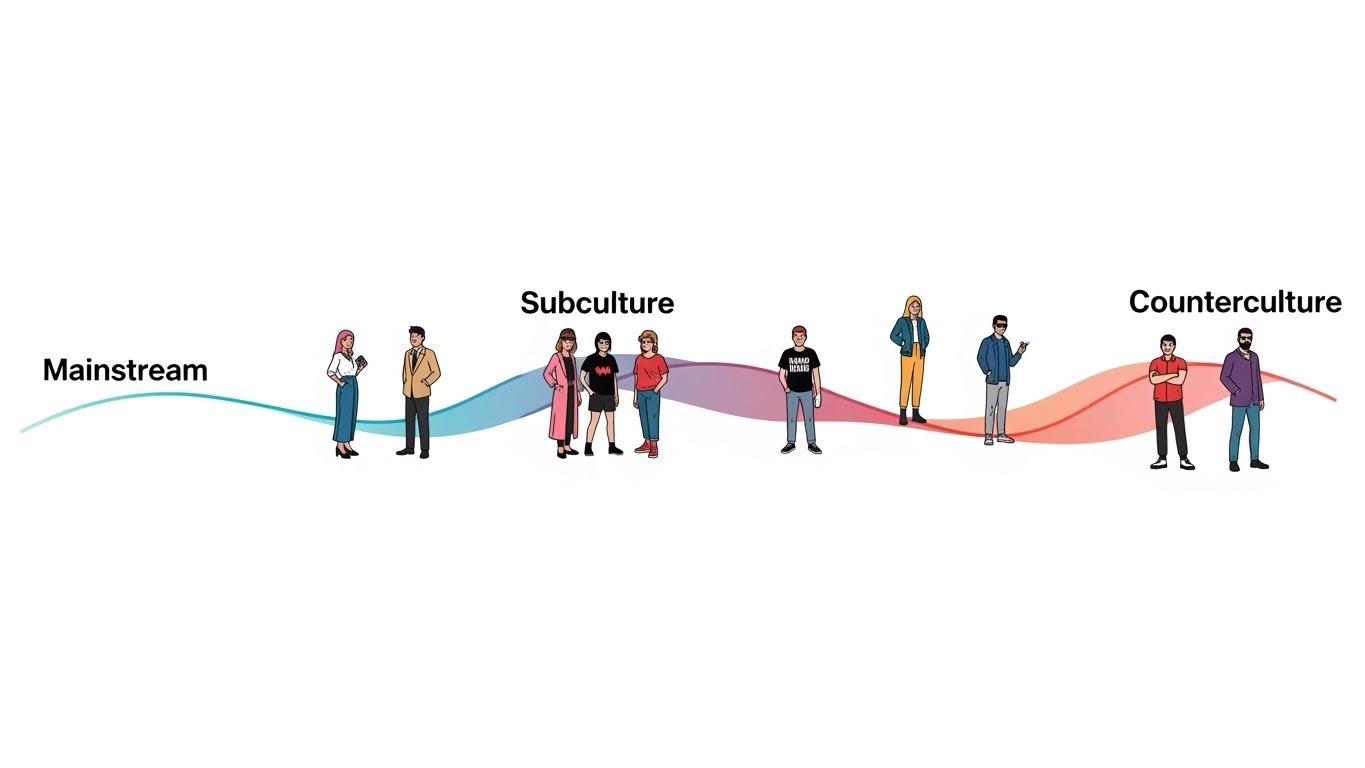
A teenager adopts the clothing, language, and music of a small social circle. A political activist rejects consumerism, distrusts established institutions, and joins a community built around a different economic model. Both people have stepped outside mainstream culture, but they have not traveled the same distance.
That distinction matters. Unusual clothing, slang, music, or hobbies may signal a subculture, yet a visible difference does not automatically mean opposition. The deeper question is whether a group creates a distinct identity within society or challenges the values that hold society together.
The Quick Takeaway: Subcultures and countercultures are related because both are smaller cultural groups that develop within a dominant culture and create their own values, norms, symbols, and identities. A counterculture is more oppositional: it rejects major parts of the dominant culture and may attempt to replace them with an alternative social order.
| Point of Comparison | Subculture | Counterculture | What Connects Them |
|---|---|---|---|
| Relationship to mainstream society | Participates in society while maintaining a distinct identity | Rejects or directly challenges important mainstream values | Both develop in response to the dominant culture |
| Primary purpose | Belonging, identity, shared interests, or lifestyle | Resistance, reform, separation, or social transformation | Both unite people around shared meanings |
| Treatment of social norms | Modifies selected norms without rejecting the entire system | Opposes norms considered unjust, restrictive, or corrupt | Both create internal expectations for members |
| Typical activities | Fashion, hobbies, language, music, rituals, gatherings | Protests, alternative communities, civil disobedience, political organizing | Both rely on symbols, communication, and group participation |
| Level of conflict | Usually limited or manageable | Often produces open conflict with institutions or authorities | Conflict depends on how strongly the group challenges power |
| Possible outcome | Remains distinct, fades, or becomes mainstream | Produces reform, faces suppression, fragments, or becomes absorbed | Both can influence the larger culture over time |
| Example | Cosplayers, motorcycle enthusiasts, regional music communities | Anti-war communes or groups rejecting consumer society | A subculture can develop countercultural branches |
What Is the Direct Relationship Between a Subculture and a Counterculture?
A subculture is a smaller cultural group whose members share characteristics that distinguish them from the larger population. Those characteristics may include language, clothing, music, beliefs, occupations, hobbies, religious practices, or common experiences. Members remain connected to the larger society even while maintaining a separate identity within it.
Countercultures also form inside a larger society, but their relationship with that society is more confrontational. Rather than creating a distinctive identity alone, members reject significant values, institutions, or behavioral expectations. They may develop alternative rules for work, family life, property, education, religion, sexuality, or political organization.
The relationship can therefore be understood as a spectrum. Every counterculture is culturally distinct, but not every distinct group is countercultural. A motorcycle club may possess its own clothing, vocabulary, ceremonies, and hierarchy while accepting mainstream laws and economic practices. A separatist community that rejects private property, conventional employment, and established government has crossed into countercultural territory. Learning how a subculture relates to a dominant culture makes this boundary easier to recognize.
Why Visible Difference Alone Does Not Make a Group Countercultural
People often classify groups by appearance. Bright hair, unusual clothing, tattoos, religious dress, or unconventional music can make a group seem rebellious. Yet sociology focuses less on appearance and more on values, behavior, and the group’s relationship with social authority.
Consider cosplay communities. Members wear elaborate costumes, use specialized language, gather at conventions, and build social identities around fictional characters. These practices differ from ordinary daily behavior, but cosplayers generally participate in mainstream education, employment, commerce, and civic life. OpenStax uses cosplay as an example of a subculture precisely because distinction can exist without broad social rejection.
Now compare that community with one that rejects wage labor, private ownership, formal schooling, and representative government. The second group is not simply expressing a preference. It is disputing the legitimacy of central institutions and proposing substitutes. The decisive issue is therefore opposition to core norms, not how unusual the group appears. Understanding how social conditioning shapes accepted behavior also helps explain why harmless differences are sometimes treated as threats.
How a Subculture Can Develop Into a Counterculture
Many groups begin with a desire for identity rather than revolution. Members find one another through music, art, religion, fashion, work, or shared frustration. The group offers friendship, recognition, and a vocabulary for experiences that members previously struggled to explain.
A change may occur when members connect their private dissatisfaction to a wider social problem. A music community, for example, might begin by celebrating a particular sound and style. Some participants may later interpret commercial media, economic inequality, censorship, or military policy as parts of a system that must be confronted. Shared taste then becomes collective resistance.
The Beat Generation and the later hippie movement illustrate this progression. Beat writers and artists formed a literary and bohemian subculture associated with jazz, spiritual inquiry, nonconformity, and rejection of materialism. Their ideas helped prepare the cultural ground for the broader 1960s counterculture, which challenged war, consumerism, traditional authority, and conventional social expectations. The Turn presents the Beat movement as a predecessor to the hippies and describes the 1967 Summer of Love as a moment when years of countercultural activity became highly visible within mainstream America.
This history shows why the terms should not be treated as sealed categories. A group may contain recreational members, artistic members, reformers, and radicals at the same time. The larger scene remains a subculture, while one branch develops a countercultural program. A fuller comparison of subculture and counterculture helps clarify how that internal division occurs.
How Countercultures Reshape the Mainstream They Oppose
Countercultures rarely remain completely separate from the societies they criticize. Their demonstrations, publications, songs, clothing, and alternative institutions attract attention. Supporters may adopt their ideas, while opponents may strengthen existing norms in response.
The 1960s counterculture combined political protest with new approaches to communal living, artistic expression, spirituality, sexuality, and personal freedom. It included peaceful activists as well as groups favoring more confrontational methods. Britannica describes it as a broad movement that rejected conventional authority and expressed itself through protests, music, communal life, and alternative lifestyles.
Over time, parts of a counterculture may enter mainstream life. Long hair, jeans, rock music, environmental awareness, and distrust of political authority once carried stronger countercultural meanings than they commonly do today. Once businesses, media organizations, schools, or political parties adopt an idea, its original oppositional force may weaken.
This process can produce meaningful reform, commercial absorption, or both. A movement may change laws and public attitudes, yet corporations may also sell its appearance without accepting its criticism. Studying the effects of counterculture on American life reveals how resistance can eventually become routine, fashionable, or institutionalized. Cultural diffusion helps explain this movement of ideas from smaller groups into wider society.
How to Determine Whether a Group Is a Subculture or Counterculture
Classification should begin with evidence rather than labels. News reports and social media posts often call any unconventional group a counterculture, even when its members are united mainly by entertainment, style, or community. A more dependable analysis examines what the group believes, how it acts, and what it hopes to change.
Use the following six-step test:
- Identify the dominant norm. Determine the mainstream value, expectation, or institution that provides the background for the group.
- List the group’s shared cultural markers. Examine its language, symbols, clothing, rituals, music, beliefs, meeting places, and communication channels.
- Measure the level of acceptance. Ask whether members accept most social institutions while expressing a distinct identity.
- Look for explicit rejection. Identify statements or actions opposing central norms such as property ownership, government authority, family structure, economic organization, or established religion.
- Examine the group’s goals and methods. Social clubs and lifestyle communities usually remain subcultural. Groups pursuing replacement, separation, or sweeping reform are more likely to be countercultural.
- Study the response from society. Tolerance often indicates a manageable difference, while censorship, arrests, public backlash, or institutional confrontation may signal a deeper cultural conflict.
Imagine a campus organization devoted to repairing clothing, thrift shopping, and vintage fashion. Its members may criticize waste, but they still purchase goods, attend school, and work through recognized organizations. It functions primarily as an environmentally conscious subculture.
Suppose a branch of that organization begins rejecting consumer markets, occupying commercial property, refusing conventional employment, and proposing communal ownership. That branch now challenges major economic norms and may qualify as a counterculture. The change is produced by goals and conduct, not by clothing. Demographic pressure, urban concentration, education, and communication networks can also accelerate such shifts, as explained in discussions of how population can stimulate social change.
Why This Relationship Matters for Understanding American Social Change
Subcultures show where people are creating identities that mainstream culture does not fully satisfy. They can provide belonging to young people, immigrants, artists, religious minorities, workers, hobbyists, or anyone whose experiences differ from the majority’s expectations. From a functionalist perspective, membership can create camaraderie and social cohesion among people with shared ideas.
Countercultures expose a deeper level of disagreement. Their members argue that existing institutions are not simply incomplete but harmful, illegitimate, or morally wrong. Conflict may center on war, racial hierarchy, economic inequality, family expectations, environmental destruction, censorship, or political power. Such groups force society to defend, revise, or abandon accepted practices.
Care is still required when applying the label. A movement demanding access to rights already promised by law may be challenging discriminatory institutions while appealing to the country’s stated principles. The American Civil Rights Movement, for instance, contained culturally distinct communities and confrontational organizations, but much of its central argument sought enforcement of constitutional citizenship rather than rejection of the constitutional system itself.
Dennis Joiner’s The Turn places these struggles within a wider account of American cultural conflict from the postwar period into the twenty-first century. Its chapters on the Beat Generation, counterculture, the Summer of Love, political change, and the decline of 1960s optimism examine how alternative groups interacted with war, media, consumerism, race, authority, and generational tension. Readers exploring what caused the decline of 1960s idealism can see how internal division, political backlash, violence, commercialization, and exhaustion can weaken a counterculture even after its ideas have influenced society.
Ultimately, subcultures and countercultures belong to the same social process. People first recognize a shared difference, build a community around it, and decide how that community should relate to established authority. Some choose coexistence. Others choose resistance. A few move between both positions as history changes around them.
Frequently Asked Questions
1. Can the same group be both a subculture and a counterculture?
Yes. A large group may function as a subculture overall while containing branches that reject core social values. Punk, environmental, religious, and political communities can include casual participants alongside committed activists seeking major institutional change.
2. What is the simplest difference between a subculture and a counterculture?
A subculture is different from mainstream culture, while a counterculture is actively opposed to important parts of it. The first seeks space for a distinct identity; the second may seek reform, separation, or replacement.
3. Can a counterculture eventually become part of mainstream culture?
Yes. Its language, clothing, music, and selected values may spread through media, commerce, education, or politics. During that transition, society may accept the group’s ideas, remove their radical meaning, or convert them into consumer products.
4. Are all protest movements considered countercultures?
No. A protest movement may demand enforcement of existing laws or stated national principles rather than reject the dominant culture. Classification depends on whether the movement seeks inclusion within the system, limited reform, or the replacement of central institutions.
5. Why do subcultures sometimes become more radical over time?
Radicalization may occur when members experience exclusion, repression, economic hardship, or repeated failure through ordinary political channels. Strong internal networks can transform shared identity into a belief that the dominant system cannot or will not address the group’s concerns.

0 Comments