


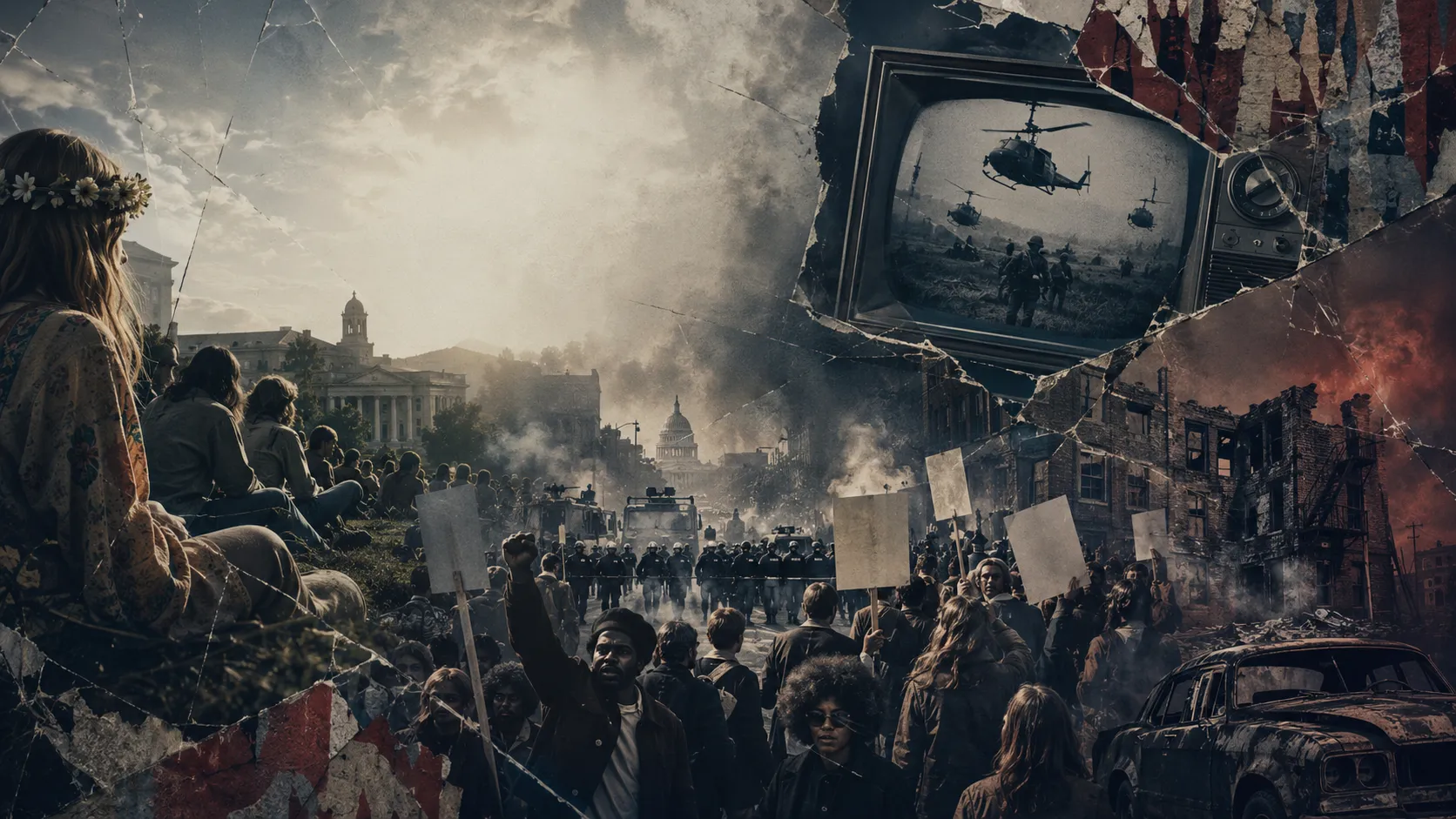
The Architecture of a Fractured Decade
The year 1968 did not arrive in a vacuum, as structural fractures hardened into place years prior. The standard narrative treats the era as a sudden, tragic derailment of social peace, but this misses a deeper reality. The early decade inherited massive economic momentum and high institutional trust, yet this optimism ignored a core historical friction. American institutions never possessed the structure for rapid expansions of human freedom, which triggered a defensive counter-reaction from elites. Highly leveraged promises of civil rights collided with an escalating proxy war, fracturing the national psyche under the pressure. State violence and internal radicalization systematically crushed idealism, driven by the cold calculations of political elites.
The Quick Takeaway: Idealism died when expensive overseas military interventions collided with domestic demands for structural justice, a failure that political gaslighting and institutional backlash accelerated.
The Variables of Cultural and Political Collapse
Specific systemic pressures map the spread of disillusionment, as competing forces undermined the core components of idealism. For instance, universal civil rights faced institutional inertia and massive white resistance, which fragmented the movement into radical factions. This structural failure left behind the lingering social wounds of the Jim Crow era that continue to resist remediation today.
Meanwhile, the government redirected Great Society capital to fund the Vietnam War, defunding urban programs and destroying trust. This shift proved to a cynical public that the ruling elite structurally maintains economic stratification. The anti-war movement faced intense state surveillance and military-industrial expansion, forcing disillusioned youth organizers into militant splinters. This dynamic fostered a permanent understanding of foreign policy as a tool driven by defense profiteering. Finally, rapid commercialization and severe internal exploitation damaged counterculture liberation, decaying the bohemian ethos into self-absorbed hedonism. This collapse created a sharp, permanent division between mainstream values and transient, commodified subcultures.
How the Vietnam War Bankrupted Domestic Reform
The rapid escalation of the Vietnam War served as the primary engine of public disillusionment across the nation. This conflict executed established containment policies, but it severely disrupted the domestic progress that the government promised. President Johnson entered office with an expansive legislative agenda to eliminate poverty through radical domestic socio-economic reform. However, a state cannot wage expensive foreign wars while simultaneously funding extensive domestic social restructuring projects. Military spending directly starved Great Society budgets, creating a profound crisis of faith among American youth.
College campuses quickly became hotbeds of resistance because the military draft forced an existential choice upon students. Idealistic youth realized their government used coercion to maintain compromised regimes abroad, prompting aggressive domestic resistance. The state responded to this dissent with surveillance, infiltration, and physical force to protect its interests. These harsh actions made it clear that public dissent faced strict, unyielding institutional boundaries.
The media played a highly dualistic role in this unravelling, serving as a primary instrument for political gaslighting and the manufacture of false reality. Nightly news broadcasts brought raw battlefield brutality directly into American living rooms, exposing the horrors of war. These graphic images directly contradicted optimistic Pentagon briefings, creating a massive credibility gap for the government. This stark disconnect destroyed the credibility of the presidency, leaving a cynical populace facing rising body counts without victory.
The Co-Optation and Fragmentation of the Counterculture
Cultural rebellion positioned itself as a total rejection of capitalist consumerism, aiming to replace conformity with communal liberation. This movement carried structural flaws from its inception, relying heavily on middle-class privilege and escapism. Early community-building efforts quickly devolved into a commercialized spectacle as corporations realized they could package and sell rebellion. This commercialization effectively neutralized the revolutionary potential of youth organizing, shifting the focus toward immediate gratification. Alternative communities collapsed under overcrowding, disease, and hard drug addiction, turning communes into dangerous environments where exploitation dominated.
The movement’s internal lack of moral seriousness accelerated its psychological descent. Predatory figures and extremist groups easily manipulated celebrated personal liberation, triggering high-profile tragedies. These shocking events deeply damaged the national conscience and destroyed the peaceful myths of the era. The Altamont concert and Manson murders closed the decade, proving that rejecting traditional norms produced chaotic nihilism.
The Backlash Against Civil Rights and Institutional Integration
Legal victories created a brief moment of intense optimism for racial equality as activists desegregated public spaces. The state protected voting access, but these legislative triumphs did not address deep, structural economic disparities. Stratification remained entrenched across society, forcing organizers to shift their focus toward northern housing segregation and employment discrimination. Consequently, the cross-racial coalition fractured as the movement challenged the core distribution of wealth.
Mainstream white America withdrew support when activists demanded economic equity, fiercely resisting any structural changes. White communities acted defensively to protect property values, local tax bases, and suburban school systems. This resistance manifested as massive white flight, which systematically drained inner cities of essential tax revenue. This migration decimated urban business districts and accelerated a long-term process of severe urban decay.
Slow real-world progress caused a major ideological split within activist organizations, as organizers questioned nonviolence. Activists frequently witnessed local law enforcement brutalizing nonviolent protestors, sparking intense internal fury. The Black Power movement rose from this justifiable anger against a broken democratic system, illustrating the clash between market justice and social justice explained during this era. Martin Luther King Jr. died by assassination in 1968, and the integrationist ideal was buried alongside him. Urban rebellions and aggressive state crackdowns followed, permanently militarizing police forces against minority populations.
A Strategy for Deconstructing Historical Political Eras
Researchers must use a systematic framework to analyze complex historical shifts and avoid repeating romanticized cultural myths. This process reveals the clear operational line between a subculture and a counterculture movement.
- Isolate Primary Institutional Drivers: Identify systems controlling capital, state power, and information while mapping federal budgets.
- Audit the Information Ecosystem: Examine how elites own mass communication channels to manage public anxiety.
- Analyze Demographic Movements: Track physical migration across urban and regional boundaries to see how zoning enforces segregation.
- Map Subculture Lifespans: Document the trajectory of grassroots movements toward their eventual commercial co-optation by corporate interests.
Frequently Asked Questions
What was the primary difference between the 1950s Beat Generation and the 1960s counterculture?
The Beat Generation remained an insular, literary subculture of intellectuals, while the counterculture grew into a mass-marketed youth movement.
How did the expansion of the interstate highway system affect urban demographics in the 1960s?
Construction cleared minority neighborhoods and isolated urban centers, which facilitated white flight and accelerated urban decay.
Why did the civil rights movement experience an ideological split in the late 1960s?
Legislative victories failed to solve housing discrimination and poverty, so frustrated organizers embraced militant self-defense.
What role did corporate media play in undermining the idealism of the youth movements?
Media outlets amplified radical elements for ratings while packaging youth aesthetics into profitable, mainstream consumer goods.
How did the federal government handle domestic opposition to the Vietnam War?
The government utilized legal coercion, police force, and covert surveillance, which heightened public paranoia and disrupted activist groups.

0 Comments