


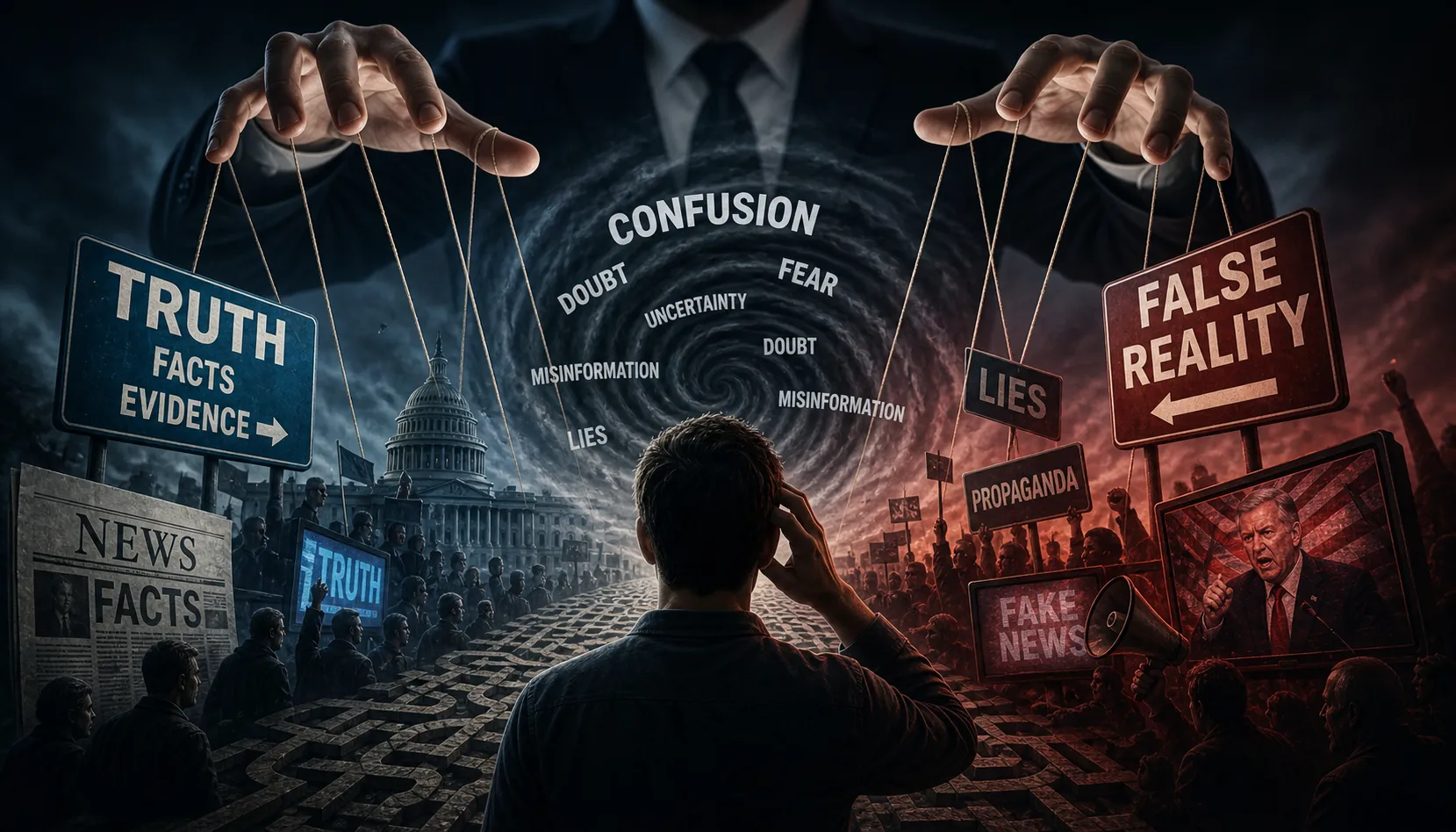
Most people think political gaslighting means a politician lied.
But that is only part of it.
A lie says, “This did not happen.” Political gaslighting goes further. Says, “You are wrong for thinking it happened.” It does not just deny the truth. It tries to make people doubt their own memory, judgment, and common sense.
That is what makes political gaslighting so harmful.
A normal political argument still allows people to share basic facts. Two citizens may disagree about taxes, war, crime, education, religion, immigration, or public spending. They may see different causes and different solutions. But they can still agree that a speech happened, a law was passed, a video exists, or a crisis took place.
Political gaslighting breaks that common ground.
It turns public life into a fog. It makes people ask, “Did I misunderstand that? Is the video fake? Are the numbers wrong? Is every news source lying? Is the truth only what my side says it is?”
Once people reach that point, false reality becomes easier to build.
What Is Political Gaslighting?
Political gaslighting is a form of public manipulation. It happens when leaders, parties, media figures, or political groups twist facts so strongly that citizens begin to question what they saw, heard, or understood.
It is not just disagreement. It’s not just bias. It is not even just lying.
Political gaslighting attacks a person’s ability to trust reality.
A public figure may say something clearly. The statement is recorded. People react. Then the same public figure, or their supporters, may say the statement was misunderstood, taken out of context, invented by enemies, or used as part of a larger plot.
The focus shifts away from the original action.
Instead of asking, “Did this happen?” people are pushed to ask, “Am I being fooled for thinking it happened?”
That shift is the point.
Political gaslighting makes citizens feel unsure, tired, and dependent on someone else to explain reality to them.
Political Gaslighting Is More Than a Lie
A lie hides a fact. Political gaslighting attacks the person who notices the fact.
A lie says, “I did not say that.”
Political gaslighting says, “Only a fool would think I said that.”
A lie says, “That report is wrong.”
Political gaslighting says, “The people who believe that report hate the country.”
A lie can be checked. A gaslighting campaign is harder to fight because it changes the whole conversation. It turns evidence into a loyalty test.
This is why political gaslighting is more dangerous than ordinary dishonesty. It does not only create false claims. It trains people to reject facts that make their side uncomfortable.
How Political Gaslighting Creates a False Reality
False reality is not created in one speech. It is built slowly. It grows through repetition, fear, confusion, and pressure.
1. Confusion Comes First
The first step is to make simple facts feel complicated.
A clear event becomes unclear. A direct quote becomes “taken out of context.” A public record becomes “suspicious.” A video becomes “edited.” A witness becomes “paid.” A court ruling becomes “corrupt.” A report becomes “fake.”
Sometimes, new information does change the story. That is normal. But political gaslighting uses confusion as a weapon.
The goal is not to clarify. The goal is to exhaust people.
When citizens are flooded with too many claims, counterclaims, accusations, and emotional reactions, many stop trying to understand what is true.
They may say, “Everyone lies anyway.”
That feeling helps gaslighters win.
2. Trusted Sources Are Attacked
The next step is to weaken every source outside the gaslighter’s control.
Journalists become enemies. Experts become paid actors. Courts become political tools. Teachers become indoctrinators. Public workers become part of a hidden plot. Former allies become traitors as soon as they speak against the leader.
This does not mean every institution is always honest. Institutions can fail. News outlets can be biased. Experts can disagree. Courts can make poor decisions.
But political gaslighting does something more extreme. It teaches people to reject any source that does not protect the preferred story.
That creates a closed circle.
The gaslighter says, “Only trust me.”
Then every fact outside that circle feels dangerous.
3. Loyalty Replaces Evidence
In a healthy public debate, evidence matters. People ask, “What happened? What proof do we have? What are the facts?”
In a gaslit political culture, loyalty matters more.
The question changes from “Is this true?” to “Whose side are you on?”
This is one of the clearest signs of political gaslighting.
A supporter may accept one version of reality today and the opposite version tomorrow. The change does not matter as long as the new version protects the same leader, party, or movement.
Contradiction becomes a test of loyalty.
If people accept the contradiction, they prove they belong.
4. Doubt Becomes Betrayal
Political gaslighting also uses shame.
Citizens who ask honest questions may be called weak, hateful, brainwashed, corrupt, anti-national, anti-freedom, or anti-people.
This creates fear around thinking.
People may stop asking questions, not because they are convinced, but because they do not want to be attacked by their own group.
That is how gaslighting spreads. It does not only control facts. It controls the emotional cost of asking about those facts.
5. The Gaslighter Becomes the “Only Truth”
After trust is broken and doubt becomes painful, the gaslighter offers one simple answer:
“Only I tell the truth.”
This is the final stage.
People stop judging claims by evidence. They wait for a trusted figure to explain what the truth should be.
That is the manufacture of false reality.
Why People Fall for Political Gaslighting
It is easy to say, “Only foolish people fall for this.”
That is not true.
Political gaslighting works because it uses normal human needs.
This is where social conditioning matters, since repeated political messages can train people to accept certain claims before they examine the evidence.
People Want Safety
Politics often feels stressful. War, inflation, crime, cultural conflict, social change, elections, pandemics, and scandals can make people feel unstable.
A simple story can feel comforting.
Even a false story can feel better than uncertainty.
People Want Belonging
Politics can become part of identity. It can shape friendships, family ties, church groups, online communities, and social circles.
When a political group accepts a false story, rejecting that story can feel lonely.
A person may think, “If I question this, will my own people turn on me?”
That fear keeps many people silent.
People Fear Being Fooled
Many people accept gaslighting because they are afraid of being tricked by the other side.
They become suspicious of everything except the voices they already trust.
But total suspicion does not always protect people. Sometimes it makes them easier to manipulate.
When every outside fact feels fake, the loudest familiar voice becomes the only guide.
People Are Tired
A tired public is easier to control.
Political gaslighting often works through overload. There is always a new outrage, new accusation, new scandal, new denial, and new distraction.
People lose the energy to check.
They may choose the version of reality that feels less painful, less embarrassing, or more loyal to their side.
People Mistake Confidence for Truth
Gaslighters often sound certain. They speak with force. They mock doubt and they repeat claims without hesitation.
Confidence can feel like honesty.
But confidence is not proof.
A false statement can be spoken boldly. A true statement can be spoken carefully. The tone is not the test. Evidence is.
Political Gaslighting vs. Propaganda
Political gaslighting and propaganda are related, but they are not the same.
Propaganda spreads a message to shape public opinion. It may use slogans, images, fear, pride, repetition, and emotional language.
Political gaslighting goes deeper. It does not only promote a message. It tries to weaken the listener’s ability to judge reality outside that message.
Propaganda says, “Believe this.”
Gaslighting says, “You cannot trust yourself unless you believe this.”
That difference matters.
A person can resist propaganda by checking facts. But political gaslighting makes fact-checking feel like betrayal, weakness, or foolishness.
Where Political Gaslighting Appears
Political gaslighting can happen in many parts of public life.
During Scandals
Scandals often begin with a visible fact: a message, recording, report, payment, meeting, policy failure, or public statement.
Political gaslighting begins when a response does not honestly address the evidence. Instead, it attacks the people who noticed the evidence.
The scandal becomes secondary.
The new story becomes: “The real problem is the people asking questions.”
When public wrongdoing is denied or delayed, many citizens feel that the wheels of justice turn slowly, which can make distrust easier to exploit.
During Elections
Election seasons are full of emotion. People fear losing power, rights, status, safety, or identity.
That makes elections a common place for gaslighting.
A candidate may claim that every bad poll is fake, every legal problem is persecution, every loss is stolen, every critic is corrupt, and every uncomfortable fact is part of a plot.
Fair election concerns should be taken seriously. But real scrutiny asks for evidence.
Gaslighting demands belief before evidence appears.
During National Crises
Crises make people afraid. War, terrorism, pandemics, economic collapse, civil unrest, and natural disasters create uncertainty.
During these moments, citizens need clear information.
Political gaslighting does the opposite. During these moments, public fear can be turned into confusion. Enemies are blamed, timelines are rewritten, mistakes are denied, and failure is presented as success even when people can clearly see otherwise.
This leaves citizens unsure of whom to trust at the exact moment when trust matters most.
During Cultural Conflict
Political gaslighting often grows around issues tied to identity: race, religion, gender, class, immigration, education, family, crime, and national history.
These topics carry deep emotion. They touch how people see themselves and their place in society.
A gaslighter can use that emotion to build a false reality.
The message may be simple: “Your group is under attack, and only we can tell you what is really happening.”
The Human Cost of Political Gaslighting
Political gaslighting does not only affect news cycles. It changes people.
Political gaslighting can leave citizens angrier, more afraid, and less willing to trust others. Over time, family relationships may suffer, neighbors may begin to see one another as enemies, and even simple conversations can start to feel like arguments.
Over time, it can also create cynicism.
Cynicism may sound smart, but it can become another trap. When people believe everyone is lying all the time, they stop looking for the truth. They stop holding leaders accountable. They stop caring.
That is useful for dishonest leaders.
A confused public can still be controlled. A cynical public can still be used. A hopeless public rarely demands better.
Short-Term vs. Long-Term Impact
The short-term impact of political gaslighting is confusion.
People argue more. Trust drops. Public conversations become louder but less useful.
The long-term impact is more serious.
A society can survive strong disagreement. It cannot function well if people cannot agree on basic facts.
If every fact becomes a partisan object, then public decision-making breaks down.
People no longer debate what should be done. They fight over whether reality exists at all.
It Rewards Dishonest Leadership
If leaders learn that denial works, they will use it again.
If they can escape accountability by attacking witnesses, facts, courts, records, journalists, or citizens, then honesty becomes optional.
The worse the behavior, the stronger the gaslighting must become.
It Makes People Easier to Control
A person who trusts nothing may think they are independent.
But if they reject every source except one leader, one party, or one media voice, they are not independent. They are dependent.
Political gaslighting creates that dependence.
It Damages Democracy
Democracy depends on citizens making choices based on some shared understanding of reality.
People do not need to agree on every issue. But they need enough shared truth to judge leaders, policies, rights, risks, and consequences.
When political gaslighting destroys that shared truth, democracy becomes weaker.
How to Recognize Political Gaslighting
Here are simple questions that can help.
Is the Speaker Denying Clear Evidence?
Disagreement is normal. But repeated denial of visible facts is a warning sign.
If the public can see the statement, read the record, or review the timeline, but the speaker still says it never happened, be careful.
Is the Speaker Attacking Your Ability to Think?
Watch for messages that make you feel foolish, disloyal, crazy, hateful, or corrupt for noticing something obvious.
This is a common gaslighting move.
The issue is no longer the fact. The issue becomes your character.
Does the Story Keep Changing?
Sometimes stories change because new facts appear.
But if every new version protects the same person from blame, the change may be manipulation.
A moving story can be harder to challenge because every correction is met with another version.
Are All Outside Sources Called Enemies?
No source is perfect. But if every outside source is framed as evil, fake, corrupt, or controlled, ask why.
A leader who wants the truth should welcome evidence.
A gaslighter wants control over where truth is allowed to come from.
Is Loyalty More Important Than Honesty?
This may be the strongest test.
If people are punished for asking honest questions but praised for defending obvious contradictions, a false reality is being built.
How to Protect Yourself From Political Gaslighting
You do not need to become cold, bitter, or suspicious of everything.
You need steady judgment.
Slow Down
Gaslighting thrives on speed. Outrage spreads faster than facts.
Before reacting, pause. Ask what is actually known.
Separate the Event From the Interpretation
First ask, “What happened?”
Then ask, “What does it mean?”
Gaslighting often mixes these two questions, so people jump straight to anger before checking the facts.
Look for Primary Evidence
Read the full quote. Watch the full clip. Look at the original document. Check the timeline.
Short clips and headlines can mislead. Longer context often helps.
Compare Sources
Do not rely on one source only, especially if that source always confirms what you already believe.
Look across different credible sources. Notice where they agree. Notice where they differ.
Watch Actions More Than Words
Words can be polished. Actions show patterns.
If a leader promises honesty but punishes truth-tellers, watch the action.
If a group says it supports freedom but silences questions inside its own circle, watch the action.
Stay Open Without Becoming Naive
Being open-minded does not mean accepting every claim.
It means being willing to follow evidence even when it challenges your side.
That is one of the best defenses against gaslighting.
Why This Topic Matters Now
Political gaslighting matters because modern citizens live inside a constant stream of messages.
News, social media, speeches, podcasts, short videos, campaign ads, memes, and comment sections all compete for attention.
This makes reality feel crowded.
A person may hear one claim in the morning, see it denied by lunch, watch it mocked by dinner, and read ten different explanations before sleeping.
In that kind of environment, the strongest voice often wins, even when it is wrong.
That is why citizens need more than information. They need judgment.
They need the ability to ask: “Who benefits if I believe this? What evidence supports it? What evidence is being ignored? Am I being asked to think, or am I being told to obey?”
Modern citizens do not just respond to facts; they also respond through today’s American worldview, which shapes how they judge truth, authority, and public events.
FAQs About Political Gaslighting
What is political gaslighting in simple words?
Political gaslighting is when leaders or political groups twist facts so much that people start doubting what they saw, heard, or understood.
Is political gaslighting the same as lying?
No. Lying hides the truth. Political gaslighting attacks your trust in your own judgment. It makes you feel wrong or foolish for noticing the truth.
Can all political sides use gaslighting?
Yes. Political gaslighting is a method. It can be used by any party, leader, movement, media group, or public figure.
Why is political gaslighting dangerous?
It weakens trust, breaks shared reality, and makes it harder for citizens to hold leaders accountable.
How can people avoid political gaslighting?
Slow down, check evidence, compare sources, watch actions, and be careful when someone says every source outside their group is fake or evil.
Conclusion: Do Not Let Anyone Own Your Reality
Political gaslighting is not just a problem of false statements. It is a problem of false reality.
It teaches people to doubt facts, distrust honest questions, and depend on powerful voices to explain what they are allowed to believe.
That is dangerous for any society.
A healthy public life needs debate. It needs disagreement. It needs strong opinions. But it also needs some shared ground where facts still matter.
The answer is not blind trust. The answer is clear judgment.
Ask better questions. Check the evidence. Watch actions. Be careful with people who punish doubt and reward blind loyalty.
Most of all, protect your ability to think.
When politics becomes foggy, remember this: confusion is often the point.
Save this article for later, share it with someone who follows politics closely, and join the discussion. What signs of political gaslighting do you think people should watch for first?

0 Comments