


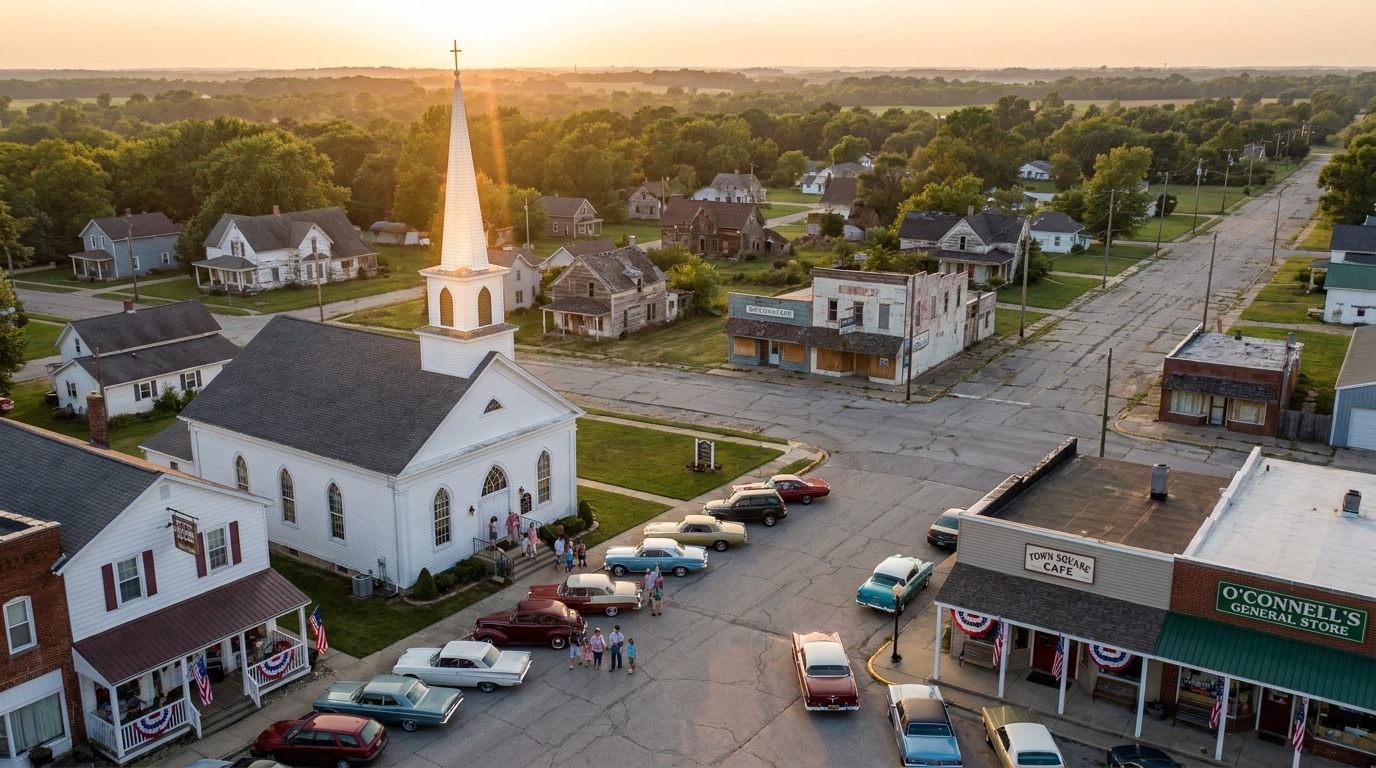
History doesn’t announce its turning points with fanfare. It whispers through frayed community bonds, hollowed-out institutions, and a creeping sense that the old certainties no longer hold. A society’s religious cohesion functions much like the mortar between bricks. When it weakens, the entire structure begins to shift. The cracks appear first in shared moral language, then in trust between strangers, and finally in the conviction that collective sacrifice serves any purpose beyond individual gain.
The Quick Takeaway:
Societies lose religious cohesion when shared rituals, beliefs, and moral frameworks that once bound people together erode across generations. This collapse triggers a cascade of social breakdowns, including family fragmentation, declining institutional trust, political polarization, and a crisis of meaning that makes collective action nearly impossible. The evidence from global data shows this isn’t about personal atheism but about the intergenerational failure to transmit a cohesive moral worldview through credible behavior.
The Participation-Importance-Belief Cascade: How Religious Cohesion Unravels
Research spanning 111 countries reveals a consistent pattern in religious decline that explains why societies fracture when cohesion dissolves. The secular transition unfolds across three distinct stages:
- Stage 1: Participation Drops. Public ritual attendance declines first. People stop showing up for collective worship, community gatherings, and shared ceremonies.
- Stage 2: Importance Fades. The personal significance of religious belief diminishes. Religion becomes peripheral rather than central to identity and decision-making.
- Stage 3: Belonging Dissolves. Formal religious affiliation slips away, often generations after participation and belief have already weakened.
This sequenced unraveling matters because it shows how societies don’t simply “stop believing” overnight. The loss of religious cohesion creeps in across decades. The pattern has been observed across countries with Christian, Muslim, Hindu, and Buddhist pluralities. Younger generations in most countries today are measurably less religious than their elders, but the form that decline takes depends on where a society sits in this transition.
This model explains the mechanics of that shattering. When ritual fades, the shared experience that binds strangers into community vanishes. As personal importance erodes, individuals lose the moral compass that once guided collective action. And when identity dissolves entirely, the society loses the very language of obligation and sacrifice.
| Criterion | Stage 1: Ritual Decline | Stage 2: Belief Erosion | Stage 3: Identity Loss |
|---|---|---|---|
| Primary Shift | Public participation in worship services drops | Personal importance of religion fades | Formal religious affiliation declines |
| Observable Sign | Empty pews, declining attendance at communal ceremonies | Religion no longer guides moral choices or life decisions | People stop identifying with any religious tradition |
| Generational Impact | Cohort differences appear first in participation gaps | Younger generations find religion irrelevant to daily life | Religious identity becomes meaningless or alien |
| Secularization Level | Country just beginning a secular transition | Country at an intermediate stage | Country highly secularized |
| Example Nations | Senegal, Nigeria, Niger | Portugal | Denmark, Netherlands |
The Five Warning Signs of Collapsing Cohesion
When religious cohesion dissolves, societies don’t simply become more “secular” in a neutral sense. They exhibit predictable patterns of decay. Religious scholar Jonathan Sacks identified five key entailments that appear when faith loses its binding power. These signs closely mirror the mechanisms described in Dennis Joiner’s historical critique of America’s “Great Cultural Turn,” where the erosion of shared moral frameworks coincides with social unraveling.
1. Human Dignity Becomes Conditional
The belief in inherent human worth, grounded in the idea that people are made in the image of God, erodes. Societies replace this with an ethic of autonomy and individual rights. This shift sounds liberating until people discover they are more vulnerable and alone. Life itself becomes disposable through abortion, euthanasia, and a casual disregard for human suffering that echoes the Tower of Babel midrash, where a shattered brick mattered more than a shattered life.
2. Politics Loses Covenantal Trust
Citizenship transforms from a sacred obligation into a transactional arrangement. When a society loses its religious foundation, individuals no longer see themselves as part of a collective enterprise requiring mutual sacrifice. They become members of “the lonely crowd or the electronic herd.” Political institutions, once seen as protecting the common good, are viewed as corrupt and self-serving.
This breakdown in trust is not merely political but existential. A society bound by shared religious ideals has a moral compass that guides collective action. When that compass disappears, cynicism becomes the default posture. The result is political polarization so extreme that citizens question not just policy but each other’s moral legitimacy. The American pattern of “red” and “blue” worlds, where citizens live on completely different political planets, represents a direct manifestation of this lost covenantal trust.
The odor of hypocrisy in modern American politics is one of the clearest signals that a society has lost its moral foundation. When leaders lie without consequence, and citizens expect deception as normal, the covenantal trust that holds democracy together has already dissolved.
3. Morality Becomes Personal Opinion
Morality doesn’t disappear in secular societies. It becomes privatized. Words like duty, obligation, honor, integrity, loyalty, and trust lose their force. These terms once pointed to objective realities that bound communities together. In their place, individuals construct personal moral codes that require nothing of them beyond self-interest.
4. The Family Fragments
The institution of marriage, historically the primary mechanism for transmitting faith and values across generations, weakens. Fewer people marry. More marriages end in divorce. Fathers lose a lifelong connection with their children. The bonds across generations grow thin. This fragmentation creates a self-reinforcing cycle because the family is the primary setting where religious cohesion is transmitted.
The decline of the family parallels the decline of society itself. When counterculture movements destroy social norms over time, the family structure is often the first casualty. What follows is a generation that lacks the moral inheritance needed to sustain a cohesive society.
5. Meaning Becomes Unattainable
People lose belief in a meaningful life. Life becomes a personal project, a series of achievements and acquisitions, without any sense of vocation, calling, or mission. The universe becomes silent. Nature becomes dumb. Life makes no demands. This is the final stage of collapse: a society where people feel unmoored and purposeless.
The Counterargument: When Religion Divides Rather Than Unites
A critical nuance to this picture is that religion itself can be a source of division, not cohesion. History demonstrates that empires and civilizations have collapsed because of religious conflict, not despite it.
The Roman Empire had no state religion binding it together, yet it extended across Europe for centuries. Christianity’s rise didn’t prevent its decline. The Reformation and Counter-Reformation wars tore Europe apart, dividing Catholic and Protestant kingdoms in conflicts that shattered the Holy Roman Empire. Islam, despite its unifying message, fractured along ethnic, sectarian, and regional lines. The Mongol Empire, one of the largest land empires in history, cared little for religion and outlasted many faith-bound dynasties.
This counterargument points to a crucial distinction: religious cohesion is not simply about belief. It is about shared moral values and a sense of covenantal duty that transcends the religion itself. When religion becomes a marker of tribal identity rather than a source of universal moral obligation, it accelerates rather than prevents collapse.
The Mechanism of Erosion: How Cohesion Dies
The data reveal that religious cohesion doesn’t vanish because people suddenly “stop believing.” It erodes because parents stop backing up their religious teachings with credible behavior. Children observe their parents’ actions. When parents teach religious values but do not practice them, the transmission fails. This is the “credibility-enhancing display” (CRED) mechanism.
When religious observance becomes optional or purely private, the next generation absorbs the underlying message: these beliefs are not actually important enough to shape daily life. The result is a society where religious identity may persist for a generation or two, but no longer exerts the binding power that once held communities together. The participation declines first, then the personal importance fades, and finally, even the identity is shed.
This pattern of erosion explains why lingering social wounds of the Jim Crow era have persisted for generations. The moral framework that should have facilitated healing and reconciliation was weakened by the same forces that undermined religious cohesion across American society.
The Media’s Role in Accelerating Collapse
Religious cohesion cannot survive in an environment saturated with propaganda, agitprop, and manufactured consent. The role of media jackals in spreading propaganda is not incidental to social collapse; it is a primary driver. When the institutions that should transmit truth instead disseminate lies, the moral consensus that binds society together dissolves from within.
The media hypocrisy as a destabilizing force in modern America operates through a simple mechanism: when citizens cannot trust what they hear from journalists, they lose trust in all institutions. The strings pulled by the American ruling elite become visible only to those who have not been fully captured by the propaganda machine. For everyone else, reality itself becomes uncertain.
Political gaslighting and the manufacture of false reality represent the final stage of this process. When citizens cannot distinguish truth from falsehood, the shared reality that makes democratic governance possible simply ceases to exist. This is what happens when a society has lost the religious and moral foundation that once anchored its perception of truth.
Practical Lessons: Restoring Social Cohesion Without Forced Faith
What can societies do when they have already lost religious cohesion? Forced religious revival rarely works. But there are actionable lessons from the patterns of collapse:
- Recognize the Sequence. Collapse happens in stages. Early intervention matters most. Once belief is lost, restoring it is far harder than preserving it.
- Support the Family. The family is the transmission mechanism for values. Policies and culture that weaken marriage and family accelerate dissolution.
- Emphasize Covenantal Duty. Civic responsibility can serve as a secular analogue to religious obligation. Societies that frame citizenship as a sacred trust, not a convenience, maintain cohesion even when organized religion declines.
- Create Shared Rituals. Participation matters. Rituals, whether religious or secular, bond communities. The loss of shared ceremony is not neutral; it actively weakens cohesion.
- Address Hyper-Individualism. Consumer culture and social media echo chambers reinforce the idea that individual preference is the only legitimate value. Countering this requires deliberate structures that force people into contact with difference and shared purpose.
- Acknowledge the Inevitable Tension. A society without religious cohesion is not necessarily doomed, as the Roman and Mongol Empires demonstrate. But the burden shifts to other institutions: civil society, shared history, and collective memory. The collapse happens when these alternatives are also weak.
Understanding what social commentary in literature reveals about societal decay provides a roadmap for recognizing the early warning signs. Fiction that explores complex social issues often captures the moral confusion that precedes collapse more accurately than academic studies.
The American Case Study: The Data Meets the Critique
Dennis Joiner’s “The Turn” describes America’s unraveling through the lens of a 75-year cultural shift away from shared religious and moral foundations. His central thesis is that this loss of cohesion created a “satanic haze of hypocrisy” where lies, propaganda, and political doublespeak replaced truth. This description aligns with the research on what happens when societies lose their moral center.
The measurable data confirms Joiner’s narrative. Declining religious participation, increasing family fragmentation, and the erosion of institutional trust have been documented in American life for decades. The emergence of hyperpolarized identity politics is consistent with a society where shared ideals have collapsed, and individuals cling to tribal identities for meaning. The American ruling elite’s manipulation of the media and political gaslighting, as described in Joiner’s critique, mirrors the social dysfunction that historically accompanies the death of a civilization’s moral consensus.
When asking what caused the death of 1960s idealism in America, the answer points directly to the erosion of religious and moral cohesion. The counterculture movements of that era, while often justified as liberating, destroyed social norms that had taken centuries to build. What replaced them was not a better moral framework but a vacuum that special interests and propaganda machines quickly filled.
The evidence points to a society that has followed the full Participation-Importance-Belonging sequence. Participation in organized religion is at historic lows. The importance of religion in daily life has plummeted, especially among younger generations. And religious affiliation continues to decline, with a growing percentage of Americans identifying as “none.” Each of these stages corresponds directly to increased social dysfunction, political polarization, and a crisis of meaning.
Conclusion
Societies collapse when they lose religious cohesion because religion provides the moral grammar that makes collective sacrifice, institutional trust, and covenantal duty seem natural. Without it, individuals retreat into isolation, family bonds weaken, and politics degrades into a war of all against all. The data shows that this process unfolds across three predictable stages: participation, then importance, then belonging. Once the final stage is reached, rebuilding cohesion requires more than policy changes. It demands a recovery of shared meaning, ritual, and trust that can only come from within.
Human beings cannot thrive without meaning. When religious institutions fail to provide it, other institutions must fill the void. But nothing has yet proven as effective at binding large, diverse populations together as shared faith. The alternative to religious cohesion is not neutral secularism but a slow, agonizing process of fragmentation that ends in the dissolution of civilization itself.
The lesson is not that every society must be religious. The lesson is that every society must have something that plays the role religion once played: a moral framework that transcends individual preference, a ritual life that binds people to each other, and a sense of collective purpose that makes sacrifice meaningful. Without this, no society survives.
FAQ
1. What specifically happens when a society loses religious cohesion?
Societies lose religious cohesion when shared rituals and beliefs erode across generations, weakening the moral frameworks that once bound communities together. This triggers predictable declines in family stability, political trust, and institutional integrity. The process follows a measurable sequence: participation in religious rituals declines first, followed by personal importance, and finally formal religious affiliation. Each stage accelerates social fragmentation.
Not inevitably. Several large empires, including the Roman and Mongol Empires, thrived without religion serving as their primary binding force. However, these empires developed alternative mechanisms for cohesion, including strong civil institutions, shared legal frameworks, and a sense of collective identity. The collapse happens when these alternatives are also weak or absent.
3. How does the family connect to religious cohesion?
The family is the primary transmission mechanism for religious values across generations. Research shows that parents who teach religiosity but do not back it up with credible behavior cause children to drop their religiosity levels. When marriage and family structure weaken, this transmission chain breaks, accelerating the secular transition and weakening social cohesion.
4. Can a society restore religious cohesion once it’s lost?
Forced religious revival rarely succeeds. Restoration requires rebuilding shared rituals and moral consensus organically, often through institutions that can serve as functional equivalents to religion. This includes strengthened civil society, family support, and community-based ritual. However, evidence suggests that restoration is far more difficult than preservation, and societies rarely reverse a completed secular transition.
5. Is political polarization a symptom or a cause of lost religious cohesion?
Political polarization is a symptom of lost religious cohesion. When religious and moral consensus erodes, politics becomes the battleground for competing worldviews. Without a shared moral framework, citizens question each other’s legitimacy rather than just disagreeing on policy. This is why addressing political polarization requires more than electoral reform; it requires rebuilding the underlying social fabric.

0 Comments