


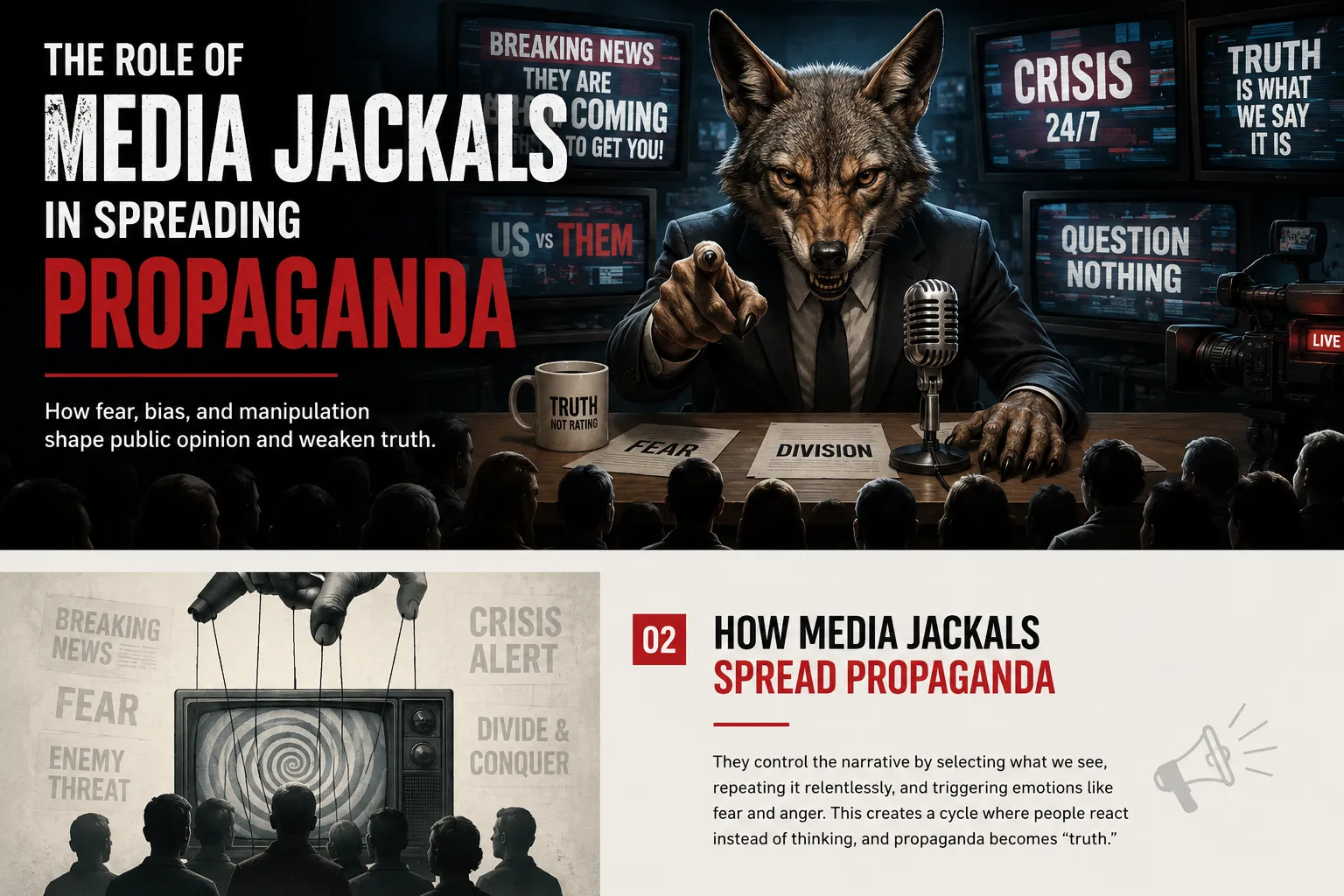
Most people think propaganda is easy to recognize. They picture a loud political speech, a wartime poster, or a government official telling the public what to believe.
In real life, propaganda often appears in quieter forms.
The Quick Takeaway: Media jackals manipulate information subtly, framing events and emotions to serve an agenda rather than truth.
It can arrive as breaking news. It can sound like concern. At times, it appears as expert opinion, public safety advice, patriotic language, or a viral post that feels too urgent to ignore.
This is where the phrase media jackals becomes useful.
The term is strong, but it points to a real issue. Media jackals are not ordinary journalists doing honest reporting. They are media figures, outlets, commentators, influencers, and public voices that feed on fear, anger, crisis, and confusion. Instead of helping people understand the truth, they shape the story to serve an agenda.
They do more than report what happened.
Their work often tells people what to feel about it.
Through careful framing, they suggest who should be blamed, who should be feared, who should be trusted, and who should be hated. Over time, this does more than mislead people. It weakens public judgment, damages trust, and turns national conversations into emotional battles.
To understand the role of media jackals in spreading propaganda, we need to look beyond fake news. The bigger issue is how information gets framed, repeated, and emotionally charged until people stop asking, “Is this true?” and start asking, “Whose side am I supposed to be on?”
What Are Media Jackals?
Media jackals are people or platforms that treat public fear and social conflict as something to feed on.
Some may work in the news. Others may appear in politics, entertainment, social media, or commentary. Their job title is not the issue. Their pattern of behavior is.
A media jackal often uses fear to keep people watching. This person may repeat claims before the facts are clear. The same voice may frame events in a way that helps one side and harms another. Context is often removed if it would make the story less dramatic. Fair questions may be attacked. Public pain becomes content. Outrage becomes the business model.
This does not mean every biased article is propaganda. It also does not mean every journalist is dishonest. Even a wrong report is not always intentional.
People make mistakes. Newsrooms move fast. Reporters can miss details.
The difference is pattern and purpose.
A journalist seeks truth, even when truth is inconvenient. A media jackal seeks influence, even when influence requires distortion.
What Is Propaganda?
Propaganda is a message designed to shape what people believe, feel, or do.
It can use lies, but it does not always need to. Some propaganda uses facts but misleadingly arranges them. It may leave out details, repeat one side of the story, or use emotional language to make people feel before they think.
That is why propaganda is so powerful.
It does not always say, “Believe this.”
Instead, it may say, “Fear this.”
Another message may say, “Trust this person.”
A third may suggest, “Hate that group.”
Sometimes, the hidden message is, “Do not question this.”
In other cases, it tells people, “You are good if you agree, and dangerous if you ask for proof.”
Once the emotion is in place, the belief becomes easier to plant.
This is one reason propaganda has always mattered in American life. Public ideas about fear, freedom, race, war, values, family, and citizenship have often been shaped through the media. Anyone studying the worst day in American history will see that tragedy is not judged only by death tolls. It is also judged by how it changes memory, policy, culture, and public trust.
Propaganda works similarly. Its real harm is not always immediate. Its deeper damage appears over time.
How Media Jackals Spread Propaganda
Media jackals spread propaganda by helping it look normal, urgent, and socially acceptable.
They act as carriers. A message may begin with a political group, corporation, state actor, activist circle, or cultural movement. Media jackals then pass that message to the public in a more emotional form.
Here is how that process works.
1. Fear Becomes a Public Habit
Fear is one of the fastest ways to control attention.
When people feel afraid, they become easier to guide. They want quick answers. Protection becomes more important than patience. Someone must be blamed.
Media jackals understand this very well.
A real issue can be made to feel like a constant threat. Alarming words are repeated. Dramatic clips are shown again and again. The same angry guests appear on screen. The most shocking image becomes the face of the entire story. Slower and calmer details are pushed aside.
A problem becomes a crisis.
A disagreement becomes a war.
A mistake becomes proof of evil.
One person becomes a symbol of everything wrong with society.
Fear may start as a reaction, but propaganda turns it into a routine.
This is especially powerful during war, elections, protests, pandemics, and social unrest. When people feel unsafe, they may accept claims they would normally question.
2. Repetition Makes a Message Feel True
Repetition is one of the oldest tools of propaganda.
A claim may sound weak the first time. After people hear it again and again, from different voices and platforms, it starts to feel familiar. Familiar things often feel true.
This is how slogans work. Political labels work the same way. Public enemies are often created through repeated framing.
Media jackals repeat the same angle until it becomes the default way to see the issue.
For example, a protest becomes “chaos.” A policy debate becomes “an attack on freedom.” A critic becomes “anti-American.” A complex social issue becomes “proof that society is collapsing.”
The danger is simple: the frame can replace the facts. People may remember the emotional label more than the actual event.
3. Selective Truth Replaces Full Context
Propaganda does not always need full lies. Half-truths often work better.
One statistic may be shown while the larger trend is hidden. A short video clip may be shared without what happened before or after. One witness may be quoted while several others are ignored. A real crime may receive heavy coverage while similar cases that do not fit the message receive little attention.
The result feels factual, but it is not fair.
This is a selective truth.
Selective truth is dangerous because it gives the audience confidence. People think they are informed because they saw evidence. In reality, the evidence was chosen to guide them to a fixed conclusion.
That is why context matters. A fact without context can become a weapon.
4. Identity Becomes a Filter
The strongest propaganda does not just change what people think. It changes how they see themselves.
At first, a person may believe a message.
Later, that person may begin to feel that good people must believe that message. Once that happens, disagreement becomes a threat to identity.
This is where propaganda becomes deeply personal.
A careful person might ask, “Is this accurate?”
A person trapped in group loyalty may ask, “What will my side think if I question this?”
This connects to the role of individualism in American society. Americans often value personal freedom and independent thinking. Yet propaganda can use that same value against people. It can make a person feel independent while quietly feeding them ready-made opinions.
Someone may think, “I made up my own mind,” while repeating a phrase that was designed for them by someone else.
5. Enemies Become Easy to Hate
Propaganda needs simple enemies.
A real human being is complicated. A propaganda target is not. The target is reduced to a label, a threat, or a symbol.
This can happen to political parties, immigrants, religious groups, racial groups, activists, teachers, journalists, police, business owners, or ordinary citizens.
Once a group is turned into a symbol, people feel less guilt about mistreating them.
That is one of propaganda’s oldest tricks. It first changes language. Then it changes feeling. Over time, it can change behavior.
For that reason, media language matters. Words can prepare the public to accept cruelty, censorship, exclusion, or violence.
Media Jackals vs. Real Journalists
A real journalist and a media jackal may talk about the same event. The difference is how they handle truth.
A real journalist tries to verify. A media jackal tries to provoke.
Responsible reporting gives context. Manipulative coverage removes context if it weakens the story.
Honest journalists correct mistakes. Media jackals often move on and let the damage remain.
Good journalism follows evidence. Propaganda-driven media follow attention, money, power, or group approval.
The best reporting helps people understand. Media jackals tell people whom to fear.
This distinction matters. If people decide that all media is corrupt, they do not become wiser. They become easier to manipulate by whoever speaks the loudest.
The answer is not blind trust. The answer is disciplined attention.
Historical Roots of Media Propaganda
Media propaganda is not new. Its form has changed, but the basic pattern remains the same.
Propaganda in War
During war, the media can help a country understand danger. It can also help leaders sell fear.
War propaganda often simplifies the enemy. Suffering may be hidden. Violence can be presented as clean, noble, and necessary. Patriotic language may be used to silence questions.
This is why education matters. A public that understands history is harder to fool. The connection between patriotism and education as traditional American values matters here. Patriotism without thought can become blind loyalty. Education without moral courage can become empty knowledge.
Healthy patriotism asks citizens to love their country enough to tell the truth about it.
Propaganda in Advertising
Propaganda is not limited to politics. Advertising has long used the same tools: emotion, identity, repetition, desire, and social pressure.
A product can become freedom.
A habit can become beauty.
A purchase can become status.
A harmful choice can be sold as empowerment.
This matters because propaganda often works best when it does not feel political. It enters daily life through entertainment, fashion, lifestyle, and consumer culture.
Propaganda in Social Change
The media has also shaped public ideas about gender, work, family, race, and class.
For example, public views about women and work changed across the twentieth century. Media images of domestic life, advertising, education, war labor, and economic need all shaped how people understood women’s roles. Readers exploring why women began to want jobs outside the home in the 1950s and 1960s can see how public opinion is rarely shaped by one event. It grows from pressure, need, messaging, and changing expectations.
Media jackals exploit these turning points. They do not simply describe change. They turn change into panic or moral theater.
Propaganda and American Social Divisions
Propaganda grows best where society already has wounds.
Race, class, geography, religion, politics, and culture can all become fuel for propaganda. Media jackals do not need to invent every conflict. Often, they take old conflicts and keep them raw.
This is why history is important.
American divisions between North and South, city and countryside, rich and poor, citizen and outsider, worker and owner, have long shaped public life. Even a basic question like how farms in the South differed from those in the North points to larger differences in labor, economy, power, and culture.
Propaganda uses these differences. It turns social tension into emotional loyalty.
One message tells a group, “You are being replaced.”
Another says, “You are being robbed.”
A third insists, “You are the only real Americans.”
Another declares, “Your pain does not matter unless it serves this cause.”
That is how propaganda divides people who may share many of the same problems.
The Role of Urban Life and Mass Media
Modern propaganda depends on speed and reach.
As cities grew, transportation changed. Newspapers expanded. Radio arrived. Television became common. Later, the internet reshaped daily life. The way people moved, worked, and received information changed public awareness.
Even questions about how urban commuting changed in the late 1800s connect to this larger story. As people moved farther between home and work, cities became more complex. Larger urban life created larger audiences. Larger audiences gave mass media more power.
The more connected people became, the faster messages could spread.
That power can inform. It can also manipulate.
Propaganda, Civil Rights, and Public Language
Civil rights history shows how powerful public language can be.
Words shape memory. They shape law. Public language also shapes how people understand justice. Even a simple writing question like whether civil rights should be capitalized points to something larger: language carries meaning.
Propaganda often fights over words.
Is a protest called a riot or a movement?
Should a law be described as protection or control?
Will a citizen be called a patriot or a threat?
Can a demand for rights be framed as justice or disorder?
Facts matter, but the words placed around those facts can change public feeling.
Media jackals know this. They choose words that place the audience on one emotional path before the full facts are even clear.
Propaganda and Citizenship
A healthy society needs citizens who can think, question, and take responsibility.
That is why civic knowledge matters. Knowing one responsibility that is only for United States citizens is not just a school lesson. It is part of understanding how citizenship works.
Propaganda weakens citizenship by turning people into spectators, fans, or followers.
A citizen asks questions.
A follower repeats slogans.
A citizen checks the evidence.
A follower protects the team.
A citizen cares about truth even when it hurts.
A follower cares only about winning.
Media jackals prefer followers because followers are easier to steer.
Short-Term Effects of Media Propaganda
The short-term effects can be fast and visible.
Propaganda can damage a person’s reputation. Panic can spread. Voters may be pushed to act from fear. Public support can be built for war, censorship, punishment, or social exclusion. Neighbors can turn against one another. A false story can trend before the truth catches up. Deeper problems can be buried under emotional noise.
A single headline can shape public belief before the facts are known. One viral clip can create anger before context arrives. A repeated claim can damage trust even after it is corrected.
This is one reason media jackals move quickly. Speed helps propaganda outrun truth.
Long-Term Effects of Media Propaganda
The long-term effects are more serious.
Over time, propaganda can make people distrust everything. It can make truth feel impossible. Every public issue can become a fight between tribes.
When this happens, people no longer debate facts. They debate identities.
A person no longer asks, “What happened?”
Instead, the question becomes, “Which side is saying this?”
That is dangerous because democracy depends on shared reality. People can disagree on policy. They can disagree on values. But if they cannot agree on basic evidence, public life begins to break down.
This is the deepest harm of media jackals. They do not just spread bad information. They train people to live in permanent suspicion.
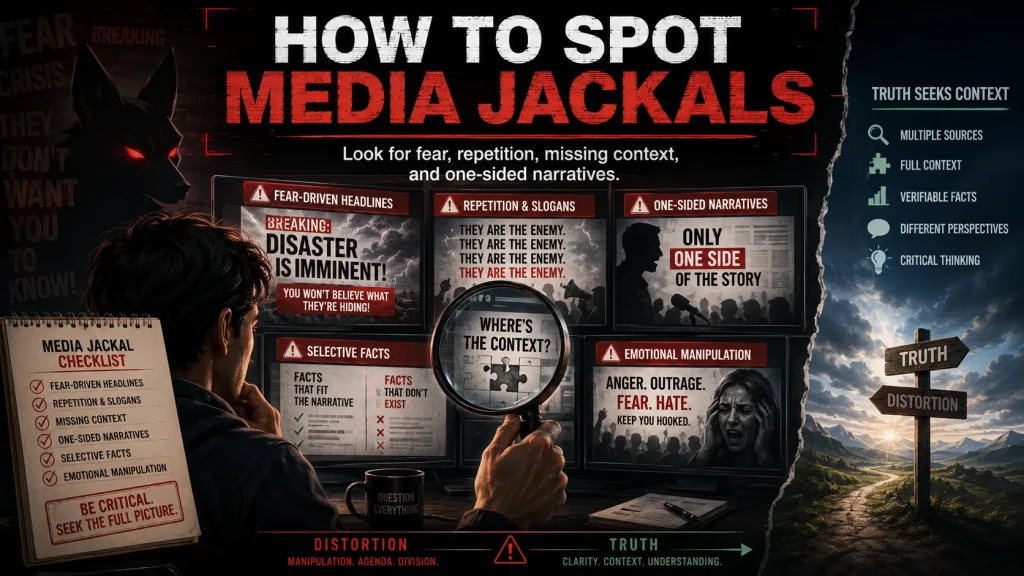
How to Spot Media Jackals
You can often recognize media jackals by their habits.
They Push Emotion Before Evidence
If a story makes you angry before it helps you understand, pause.
Strong emotion is not always wrong. Propaganda, however, often uses emotion to stop questions.
They Use Labels Instead of Explanation
Words like traitor, enemy, puppet, extremist, monster, savior, or threat can replace careful thought.
Ask what the label is hiding.
They Leave Out Context
If a clip, quote, or statistic seems shocking, look for the full version.
What happened before?
What happened after?
Which details are missing?
They Treat Questions as Betrayal
One of the clearest signs of propaganda is hostility to honest questions.
If asking for proof makes someone call you evil, dangerous, or disloyal, be careful.
They Always Protect One Side
No side is right all the time. If a media voice never admits fault from its own side, it is probably not informing you. It is training you.
Why People Believe Propaganda
People do not fall for propaganda because they are foolish. They fall for it because they are human.
People want safety. Belonging matters to them. Simple answers feel good during stress. Familiar voices feel trustworthy. Moral certainty can feel comforting. Blame can feel like relief when life feels unfair.
Media jackals understand this. Anger keeps people watching. Fear keeps people sharing. Group loyalty keeps people coming back.
The way to resist propaganda is not to become emotionless. It is to slow down long enough for reason to catch up.
How to Protect Yourself From Propaganda
Start with a few simple habits.
Read beyond the headline.
Check whether the story gives evidence or just emotion.
Look for the source.
Compare more than one outlet, especially outlets that do not share the same bias.
Ask who benefits from the message.
Notice when a story makes you feel certain too quickly.
Be careful with content that tells you exactly whom to hate.
Most of all, stay humble. Anyone can be misled. Propaganda works best on people who think they are immune to it.
FAQs About Media Jackals and Propaganda
What is the role of media jackals in spreading propaganda?
Media jackals help propaganda spread by making it emotional, familiar, and socially acceptable. They repeat messages, frame events, select facts, attack dissent, and turn public issues into fear-based stories.
Are all journalists media jackals?
No. Many journalists work hard to verify facts, expose corruption, and inform the public. The term media jackals should be used for people or outlets that show a repeated pattern of manipulation, fearmongering, and dishonest framing.
Is propaganda always false?
No. Propaganda can include facts. The problem is how those facts are selected, framed, repeated, and used to push people into a fixed belief or action.
Why is propaganda so effective?
Propaganda works because it speaks to emotion first. It uses fear, anger, pride, guilt, and belonging. Once people feel strongly, they are more likely to accept the message without checking it carefully.
How can I tell if I am being manipulated by the media?
Ask yourself: Is this story giving me facts or just feelings? Is the key context missing? Is one side always pure and the other always evil? Am I being pushed to react before I understand? If yes, slow down and check other sources.
Conclusion: The Real Battle Is for Clear Thinking
The role of media jackals in spreading propaganda is not just to pass along false claims. Their deeper role is to shape public emotion until people stop thinking clearly.
Fear becomes attention.
Attention becomes belief.
Belief becomes loyalty.
Loyalty becomes action.
That is why media literacy matters. A free society needs real journalism. It also needs citizens who can tell the difference between reporting and manipulation.
The answer is not blind trust. Total distrust is not the answer either.
Clear thinking is the better path.
The next time a headline makes you angry, afraid, or certain within seconds, pause. Ask what is being shown, what is being hidden, who benefits, and whether the story helps you understand reality or simply tells you whom to hate.
If this article helped you think deeper about propaganda and media influence, save it, share it, or leave your thoughts in the comments. The discussion matters because truth survives best when people are willing to slow down and think together.

0 Comments