


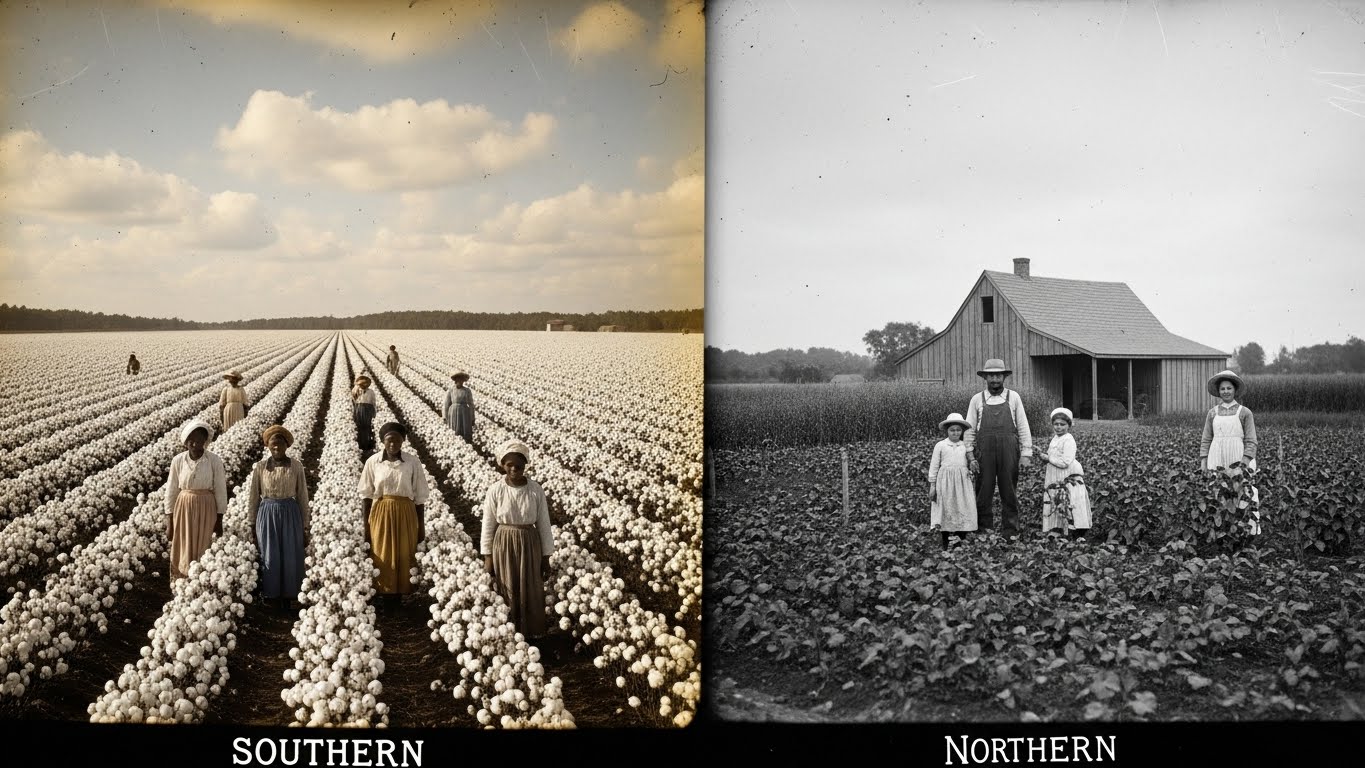
When students ask what was the primary way the farms in the South differed from those in the North? They are really probing the foundation of how two regional economies shaped a nation’s history. Behind the simple classroom answer lies a story about land use, labor systems, market connections, and the economic decisions that helped push the United States toward internal conflict.
The Quick Takeaway: Southern farms were organized around large-scale plantation agriculture that focused on cash crops like cotton and tobacco and depended heavily on enslaved labor. Northern farms were smaller, diversified, oriented toward local and regional needs, and operated with free family labor. (source)
Understanding this distinction helps explain more than agricultural history. It clarifies why regional social orders, labor markets, and political interests diverged so sharply before the Civil War.
Core Differences in Southern and Northern Farming
| Aspect | Southern Farms | Northern Farms |
|---|---|---|
| Primary Purpose | Export-oriented cash crops (cotton, tobacco, rice) | Local/regional food and mixed crop production |
| Scale of Operation | Large plantations covering hundreds or thousands of acres | Smaller family farms, often under 200 acres |
| Labor System | Relied on enslaved labor | Primarily free family labor and paid workers |
| Economic Connectivity | Tightly linked to global markets and commodity prices | Connected to local markets and growing industrial centers |
| Social Structure | Hierarchical, oligarchic landownership | More egalitarian, community-based agrarian society |
| Technology Adoption | Plantation machinery, but a slow industrial transition | Increasing mechanization and industrial integration |
This table breaks the topic down across the most commonly asked dimensions. Each of these lines is grounded in how people actually lived, worked, and traded in the antebellum United States. For a deeper understanding of how social structures affect communities, see what role individualism plays in American society.
Why “Cash Crops” and “Plantations” Were the Defining Features of Southern Farms
The South’s geography and climate offered long growing seasons and fertile soil, ideal for crops like tobacco, rice, sugar, and especially cotton. The cotton gin, invented in 1793, dramatically reduced labor for separating fibers from seeds, allowing plantations to expand rapidly. These plantations were usually vast estates, far larger than typical Northern farms, and designed to produce high-value cash crops for domestic and international markets. (reference)
Cash crop dependence shaped the Southern economy, making it vulnerable to commodity price fluctuations and directly tying wealth to the number of enslaved people on a plantation. The South’s focus on exports created a very different social and economic structure compared with the North, where farms supported local communities and urban centers.
How Labor Systems Drove Divergence
Southern plantation agriculture relied heavily on enslaved African labor, while Northern farms depended on free family labor and paid workers. This difference was the primary economic distinction that influenced political, social, and cultural development in each region. For a historical perspective on social hierarchies and the power of systemic structures, see Market Justice vs Social Justice Explained.
In the South, enslaved labor was central to the production of wealth, giving rise to hierarchical social structures dominated by wealthy landowners. In the North, free labor allowed for smaller farms, a more egalitarian social order, and the rise of diversified local economies. These differences contributed to the regional tensions that eventually culminated in the Civil War.
Diversified Small Farms in the North
Northern farms prioritized crop diversity to sustain both families and local markets. Farmers raised corn, wheat, oats, and vegetables, while also keeping livestock. Unlike the Southern plantation system, which was export-focused, Northern agriculture emphasized subsistence and regional commerce. See sociology vs political science for insight into how community structures influenced Northern social dynamics.
Northern farms were integrated with local towns and industrial centers, creating an interconnected economic system. These farmers were less vulnerable to fluctuations in global commodity prices because they relied on multiple crops and livestock for both survival and profit.
Landownership, Economy, and Social Structures
Southern plantations concentrated wealth and political influence in a small elite, reinforcing oligarchic power structures. Northern farms fostered a more distributed economic base, with a strong emphasis on local markets, community governance, and social cohesion. These structural differences shaped regional responses to national legislation, infrastructure projects, and social reforms. For cultural and social implications of hierarchical structures, see patriotism and education, which are traditional American values.
Practical Implications for Understanding Historical Change
- Study Primary Sources: Examine plantation records and farm diaries to see the operational and labor differences between Southern and Northern farms.
- Visit Historical Sites: Museums and preserved farms provide tangible evidence of scale and diversity, showing the physical layout and labor systems firsthand.
- Analyze Agricultural Output Data: Census records reveal production levels, crop types, and labor practices.
- Map Transportation Networks: Understand how canals, railroads, and ports influenced the flow of goods and the profitability of different farm models.
- Explore Economic Linkages: Compare how Northern and Southern farms fed local markets versus international trade, influencing regional industrialization.
Real-World Scenario: Cotton vs Corn
Consider a Georgia plantation in 1840: enslaved workers cultivate cotton over hundreds of acres for export. In contrast, a Northern farm in upstate New York grows corn, wheat, and vegetables for local markets, relying on family labor. These contrasting approaches illustrate why economic, social, and political structures diverged sharply between regions.
How These Farming Differences Shaped National Conflict
The South’s reliance on enslaved labor and export crops affected its political priorities, creating resistance to policies that could threaten slavery. Northern small farms fostered different economic and social views. Understanding these differences provides insight into how economic structures fueled sectional tensions and led to the Civil War. For more on the cultural and historical framing of events, see The worst day in American history is not what you think.
FAQ
1. What differences existed between the North and South by the end of the 1830s?
By the late 1830s, the North had developed small, diversified farms and was increasingly industrialized, while the South relied on large plantations growing cash crops like cotton and tobacco using enslaved labor. Regional economies, social structures, and political interests were already diverging.
2. What three ways in which the North and the South differed in the mid-1800s?
The North and South differed in three key ways: (1) labor systems — free labor vs. enslaved labor, (2) farm types — small diversified family farms vs. large cash-crop plantations, and (3) economic orientation — local/regional markets vs. export-oriented agriculture.
3. What were the main differences between the North and the South?
Northern farms were smaller, diversified, and used free labor to supply local markets. Southern farms were large, monoculture plantations producing cash crops for export and relying heavily on enslaved labor, creating distinct social hierarchies.
4. What were the main differences between the northern and southern economies, and how did these differences influence attitudes toward slavery?
The Northern economy favored industrial growth and small-scale agriculture, promoting free labor, while the Southern economy depended on plantation crops and slave labor. Economic reliance on slavery strengthened Southern resistance to abolition and shaped political and social divisions.
5. Which difference between the North and the South grew larger before the Civil War?
The most pronounced growing difference was the reliance on labor systems: Northern free labor vs. Southern enslaved labor. This gap intensified economic, social, and political tensions, leading to the Civil War.
6. Why did Southern farms focus on cash crops instead of food crops?
Southern climate and soil favored profitable cash crops like cotton and tobacco. Plantation owners emphasized these crops for export markets. (source)
7. Could Northern farms have used enslaved labor like the South?
Most Northern states abolished slavery, and economies relied on free labor. Small-scale, family-run operations did not require enslaved labor, unlike Southern plantations. (source)
It concentrated wealth and political power among a few landowners, creating a hierarchical society. (source)
9. Did the North produce any cash crops?
Northern farms occasionally sold grains or vegetables beyond local needs, but they mainly focused on diversified crops for regional consumption. (source)
10. What historical consequences arose from these agricultural differences?
Divergent farming systems shaped regional economies, labor practices, and political priorities, contributing directly to the sectional tensions that caused the Civil War. (source)

0 Comments