


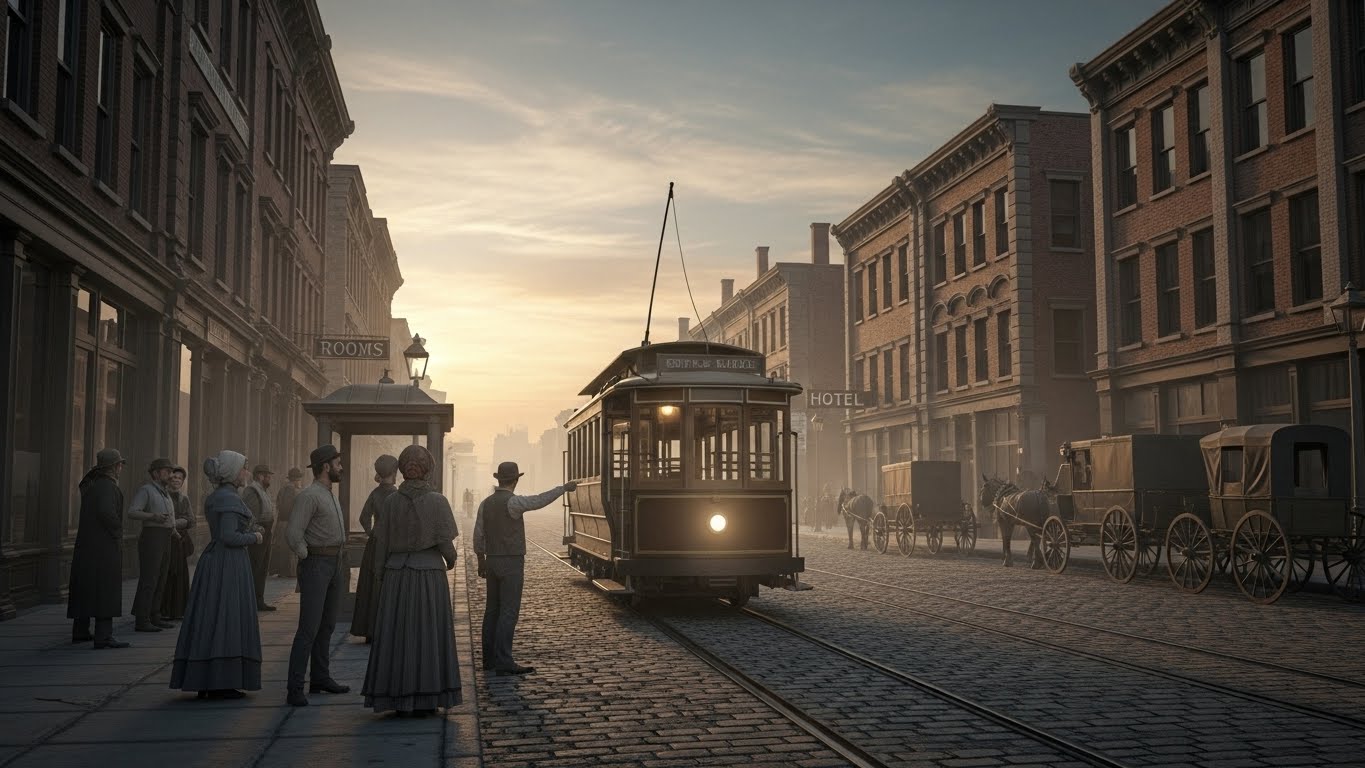
Picture two American workers living less than a generation apart. The first walks from a crowded neighborhood to a nearby factory because daily travel is slow and limited. The second boards an electric streetcar and rides several miles from a quieter residential district to a job downtown.
That difference captures one of the most important urban changes of the late nineteenth century. Cities were no longer organized solely around the distance an ordinary person could cover on foot. New transit systems expanded the practical boundaries of daily life, separated workplaces from residential neighborhoods, and helped create the early metropolitan landscape.
The Quick Takeaway: Urban commuting became faster and more dependent on public transportation, allowing many people to live farther from their workplaces. Electric streetcars, commuter railroads, cable cars, and elevated trains helped cities expand outward and encouraged the development of residential suburbs.
| Point of comparison | Earlier nineteenth-century pattern | Late 1800s pattern | Result for American cities |
|---|---|---|---|
| Compact “walking city.” | Walking or short horse-drawn trips | Streetcars, commuter trains, cable cars, and elevated rail | Workers could travel farther in a reasonable amount of time |
| Distance between home and work | Usually short | Increasingly several miles | Residential and commercial districts became more separated |
| Urban form | Compact “walking city” | Transit corridors extending from the central city | Cities developed outward along rail and streetcar lines |
| Housing pattern | Dense housing near factories and shops | New neighborhoods near transit stops | Streetcar and railroad suburbs expanded |
| Daily schedule | Shaped by walking distance and local employment | Shaped by routes, fares, stops, and timetables | Commuting became a regular part of working life |
| Main transportation revolution | Human and animal power | Electrified mass transit | The automobile had not yet become the dominant commuter vehicle |
The National Park Service reports that an electric streetcar could carry a passenger in ten minutes, roughly as far as that person could walk in thirty. Streetcar track mileage grew from 5,783 miles in 1890 to 34,404 miles in 1907, showing how rapidly the transit-based city expanded around the turn of the century.
The Best Answer Is That Mass Transit Allowed People to Live Farther from Work
The most accurate statement is: Urban commuting became easier and faster as mass transit systems expanded, allowing people to live farther from their workplaces. This answer identifies both the technological change and its geographic effect. Streetcars did more than replace walking or horse-drawn vehicles. They increased the distance a person could cover during an ordinary workday.
Before widespread urban transit, most residents needed to live reasonably close to factories, offices, markets, and workshops. A long walk consumed time and physical energy, while private carriages were beyond the means of most working families. Commuter railroads offered an earlier option, but their fares and station-based service often made them more accessible to affluent households than to ordinary wage earners. The electric streetcar reached a broader portion of the urban population by offering frequent stops and relatively inexpensive service.
An answer claiming that automobiles caused the transformation would be historically misplaced. Cars existed experimentally during the late nineteenth century, but mass automobile ownership did not shape everyday commuting until the twentieth century. Henry Ford began selling the Model T in 1908, after streetcars had already changed the geography of many American cities.
Why Urban Commuting Changed So Quickly During the Late 1800s
Industrialization concentrated jobs, capital, factories, and commercial activity in growing cities. At the same time, immigration and domestic migration increased the urban population. Census history shows that the number and size of American cities rose dramatically from 1790 to 1890, with large cities accounting for an increasing share of the urban population by the end of that period. This relationship between demographic pressure and institutional change is examined more broadly in discussions of how population stimulates social change.
Transportation technology supplied a practical response to that growth. Horse-drawn streetcars had already allowed passengers to travel along fixed rails, but horses required food, care, rest, and large urban stables. Cable systems worked well in places such as San Francisco, particularly on steep streets. Electrification then made urban rail service faster, easier to extend, and more dependable across growing networks. The introduction of Frank J. Sprague’s electric streetcar system in Richmond, Virginia, in 1887 helped begin a new stage of suburban development.
Economic interests accelerated the process. Real estate developers sometimes financed or constructed transit lines to make undeveloped land attractive to homebuyers. Once a trolley line connected an outlying tract with a business district, farmland or open land could become a residential neighborhood. Transportation, therefore, affected property values, commercial investment, and settlement patterns, much as larger transportation networks later influenced trade and the relationship between transportation and globalization.
How Streetcars Changed the Physical Shape of American Cities
Streetcar routes often extended outward from central business districts like spokes from a wheel. Housing appeared along these corridors, producing long bands of development rather than isolated settlements. Since streetcars stopped frequently, developers commonly placed houses within a five- or ten-minute walk of the line. Shops, bakeries, pharmacies, and apartment buildings gathered around busy intersections and transfer points.
Consider a hypothetical clerk working in downtown Washington, D.C., in 1895. Without reliable transit, the clerk might rent a room within walking distance of the office. Once a streetcar reached an outlying neighborhood, the same worker could rent or purchase a larger home farther away, board the trolley each morning, and still reach the downtown workplace on schedule. The Smithsonian records that Washington’s streetcars turned outlying areas into neighborhoods and connected residents with jobs, shopping areas, and public markets.
This was an early form of suburbanization, though it differed from the car-dependent expansion that followed World War II. Late nineteenth-century suburbs remained closely tied to fixed tracks and transit stops. Twentieth-century automobile suburbs could spread across a much wider area. Understanding that distinction helps clarify comparisons between gentrification and suburbanization and their socioeconomic effects.
Commuting Changed Daily Life, Not Just Travel Distance
Regular commuting introduced a sharper separation between working life and domestic life. A person could earn wages in a central industrial or commercial district while maintaining a household in a residential neighborhood several miles away. Employers gained access to workers from a larger geographic area, while families gained more choices about where to live, provided they could afford the fare and find suitable housing near a route.
Time also became more closely connected with public schedules. Workers had to reach stops, catch particular cars, account for transfers, and arrive before the start of a shift. Missing a trolley could mean arriving late for work. Daily movement became organized around transit timetables instead of sunlight, walking speed, or the distance between a tenement and a factory gate.
Commercial routines changed as well. Streetcars carried people downtown for shopping, entertainment, worship, and social gatherings. Neighborhood businesses then emerged around heavily used transit stops. A transportation route could determine where a grocer opened a store, where apartment buildings were constructed, and which intersection became a local commercial center. These patterns show why transportation history belongs beside economics, geography, and the study of sociology compared with political science.
What the Simple Textbook Answer Often Leaves Out
The benefits of expanded commuting were unevenly distributed. Railroad suburbs had initially favored households that could afford higher fares, while horsecar and streetcar districts tended to serve middle-class and working-class residents closer to the central city. The cost of transportation remained a major factor in determining where families could live.
Race also affected access to transportation and housing. Public transportation operated within a society shaped by segregation, discriminatory laws, and unequal treatment. The legal arguments surrounding Plessy v. Ferguson in 1896 explicitly addressed racial separation in railroad coaches and streetcars. Even where a transit line physically connected a neighborhood to the city, discriminatory practices could restrict who rode freely, who purchased property, and who benefited from rising land values.
Urban transit, therefore, produced both mobility and new divisions. It opened land for housing, yet access to that land was filtered through income, race, lending practices, and local policy. It gave individuals greater residential choice, but that freedom depended on systems beyond personal effort. This tension between individual opportunity and social structure also appears in discussions of the role of individualism in American society.
How to Identify the Correct Answer on a History Test
Multiple-choice questions about transportation often mix developments from several periods. One option may describe streetcars accurately, while another mentions highways, automobiles, airplanes, or postwar suburbs. The fastest way to answer correctly is to connect the stated period with the transportation system that dominated it.
Use the following sequence:
- Mark the period. “Late 1800s” usually refers to the final decades of the nineteenth century, particularly the 1870s through the 1890s.
- Identify the era’s transportation breakthrough. Look for railroads, cable cars, elevated trains, and electric streetcars.
- Connect transportation with distance. Faster public transit allowed daily travel across a larger area.
- Connect distance with urban form. People could live farther from central workplaces, encouraging outward residential development.
- Reject later developments. Automobile commuting, interstate highways, and large car-centered suburbs belong mainly to the twentieth century.
- Choose the answer that explains both cause and effect. The strongest choice should mention expanded mass transit and greater separation between homes and workplaces.
Suppose the choices include: people stopped traveling to work, factories moved entirely into rural areas, automobiles allowed universal suburban living, or mass transit let workers commute from more distant neighborhoods. The fourth answer is strongest. It fits the technology, timeline, and geographic transformation documented by historical transportation records.
This method also prevents a common error: selecting a true statement from the wrong era. Cars eventually changed commuting far more dramatically, but that does not make automobile-centered answers correct for the late 1800s. Historical reasoning requires placing each development in its proper sequence.
Why This Question Matters Beyond a Single Multiple-Choice Answer
Urban commuting illustrates how a technological system can reorganize society without changing human needs. People still needed employment, housing, food, and community. What changed was the geographic relationship among those needs. Transit allowed home, work, shopping, and recreation to occupy separate parts of an expanding city.
That cause-and-effect perspective fits the broader historical approach of Dennis Joiner’s The Turn, which examines how major events, institutions, and social changes altered American life over time. Although the book concentrates primarily on developments from the postwar period through the early twenty-first century, the late nineteenth-century transit revolution provides an earlier example of infrastructure changing everyday behavior and community structure.
The streetcar city also established a foundation for later metropolitan growth. In the 1950s, automobiles and highways extended commuting far beyond the fixed corridors created by nineteenth-century rail transit. The technology changed, but the central relationship remained: transportation determined how far people could live from work, which land could be developed, and which groups gained access to new opportunities.
Sources and Further Reading
- National Museum of American History: A Streetcar City
- National Park Service: Historic Residential Suburbs in the United States
- Library of Congress: Transportation Primary Source Set
- U.S. Census Bureau: Increasing Urbanization, 1790 to 1890
- National Archives: Plessy v. Ferguson
Frequently Asked Questions
Did automobiles cause the major change in urban commuting during the late 1800s?
No. Electric streetcars, commuter railroads, cable cars, and elevated trains were the principal forces behind the change. Automobiles became a major influence on ordinary commuting during the twentieth century.
What invention had the greatest effect on late nineteenth-century urban commuting?
The electric streetcar had one of the broadest effects. It provided frequent, relatively affordable service and allowed transit routes to extend into developing residential areas beyond the older walking city.
How did improved commuting encourage suburban growth?
Transit reduced the time and cost required to travel between outlying land and central workplaces. Developers could build homes along streetcar and railroad routes, while residents could live outside crowded commercial and industrial districts.
Did every urban worker benefit equally from expanded transportation?
No. Fares, wages, racial discrimination, housing restrictions, and access to transit routes shaped who could benefit. Middle-class households generally had more freedom to relocate than poor workers, while segregation limited opportunities for many Black Americans.
What is the difference between a railroad suburb and a streetcar suburb?
Railroad suburbs usually developed around stations with greater distances between stops and often served wealthier commuters. Streetcar suburbs formed more continuous corridors because trolleys stopped frequently, allowing homes and shops to develop along the length of the route.

0 Comments