


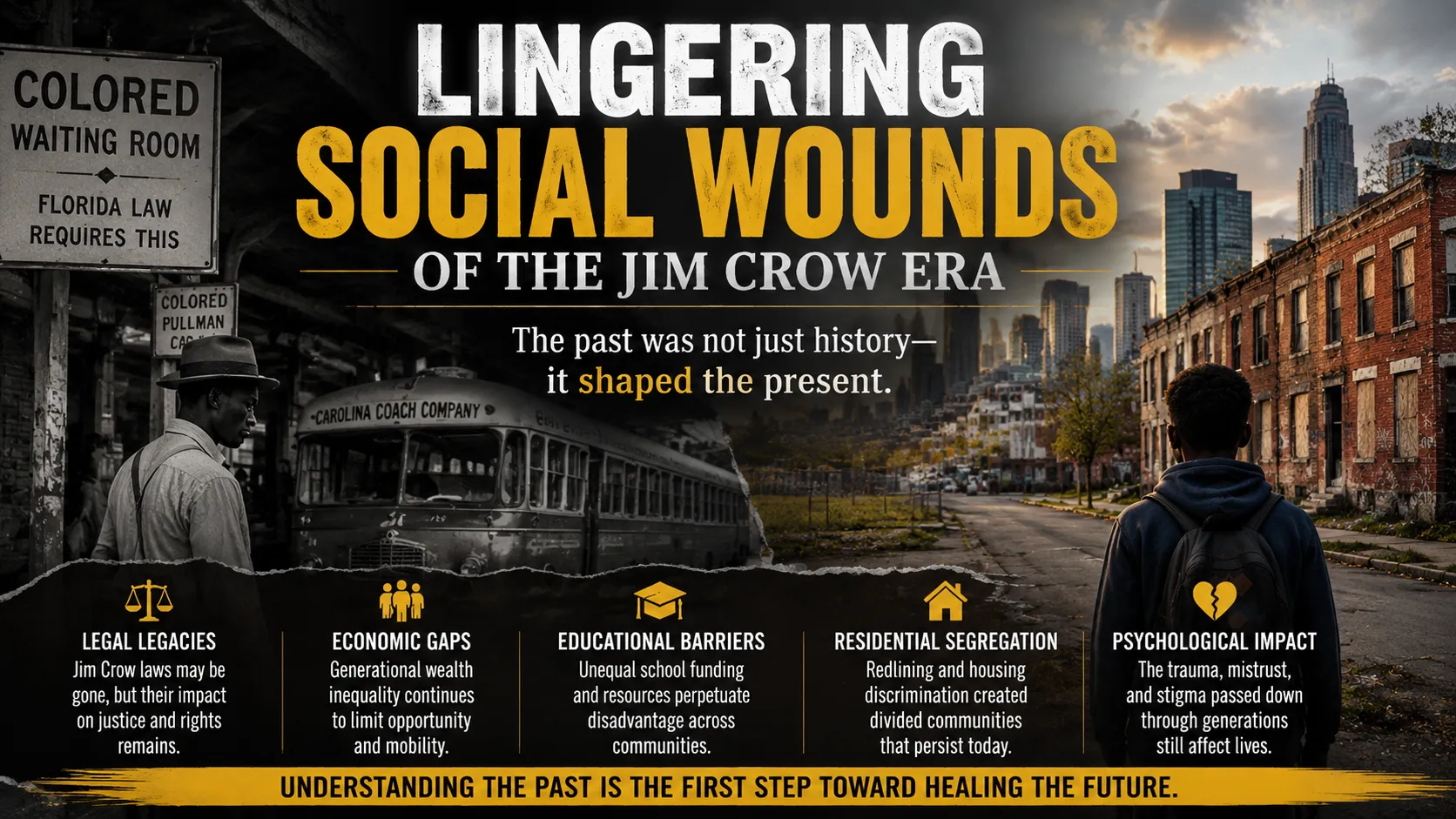
Even decades after its formal end, the Jim Crow era continues to shape social, economic, and psychological realities in the United States. The systemic marginalization of Black Americans created patterns of inequality and trauma that persist across neighborhoods, schools, and institutions.
The Quick Takeaway: The lingering social wounds of the Jim Crow era manifest through persistent racial disparities in wealth, education, housing, and social mobility. Understanding this legacy is essential for addressing structural inequities and building a more equitable society.
Core Comparison Matrix: Social Legacy of Jim Crow
| Dimension | Historical Mechanism | Contemporary Impact | Example / Case Study |
|---|---|---|---|
| Education | Segregated schools, unequal funding | Achievement gaps, under-resourced schools in predominantly Black neighborhoods | Brown v. Board of Education overturned “separate but equal,” but many districts remain effectively segregated due to housing patterns and redlining |
| Housing | Redlining, restrictive covenants, and suburban exclusion | Wealth gaps, limited homeownership for Black families | Interstate highway construction and Levittown developments favored white Americans, displacing Black communities |
| Voting Rights | Literacy tests, poll taxes, and all-white primaries | Suppressed Black political influence, delayed representation | The Voting Rights Act of 1965 addressed overt barriers, but voter suppression tactics continue in some states |
| Employment & Economic Mobility | Job discrimination, exclusion from unions | Persistent wage gaps, limited career opportunities | Post-WWII G.I. Bill favored white veterans, leaving Black veterans marginalized |
| Cultural Perceptions & Media | Stereotyping, minstrel shows, and biased media | Implicit bias, social stigma, systemic prejudice | TV shows in the 1950s broadcast demeaning Black stereotypes, shaping generational perceptions |
Understanding Why These Wounds Persist
How Segregation Influenced Long-Term Socioeconomic Outcomes
Jim Crow laws didn’t simply deny rights—they structured society to maintain racial hierarchies. Black Americans faced barriers in accessing high-quality education, healthcare, and home loans. When suburban neighborhoods became white-only, concentrated urban poverty emerged. Today, Black families often inherit wealth disparities rooted in this historical exclusion, a problem compounded by ongoing economic bias.
Psychological and Cultural Trauma
The cumulative effect of intimidation, lynching, and systemic marginalization created intergenerational trauma. Communities lived under constant threat of violence, and children internalized a racialized sense of inferiority. Modern psychological research links historical oppression to chronic stress, reduced life expectancy, and heightened vulnerability to social instability.
The Role of Media and Cultural Narratives
Stereotypes reinforced by films, television, and advertisements normalized racist attitudes. As early as the 1950s, mainstream media depicted Black Americans as lazy, superstitious, or hypersexualized. These portrayals validated discriminatory practices and shaped collective societal attitudes, reinforcing systemic inequities that persist in hiring, policing, and cultural representation.
Key Mechanisms That Sustain the Legacy Today
- Residential Segregation and Wealth Gaps
- Redlining and covenants segregated neighborhoods and restricted Black access to homeownership.
- Suburban infrastructure (highways, Levittowns) prioritized white mobility, effectively freezing Black families in declining urban centers.
- Education Inequity
- Schools funded by local property taxes reflect historic segregation.
- Underfunded schools perpetuate cycles of limited opportunity and reduced social mobility.
- Employment and Income Disparities
- Historical exclusion from unions and skilled labor markets continues to affect generational income.
- Black Americans are disproportionately represented in lower-wage industries, reflecting structural inequities from Jim Crow-era policies.
- Criminal Justice Disparities
- Policies such as voter suppression, mass incarceration, and over-policing mirror the control mechanisms of Jim Crow.
- Criminal records disproportionately affect Black citizens, limiting housing, employment, and political participation.
- Health Outcomes
- Restricted access to healthcare during Jim Crow, combined with ongoing structural bias, contributes to higher morbidity and mortality among Black Americans.
- Environmental and occupational exposure disparities reinforce systemic health inequities.
How to Apply This Understanding Practically
- Audit Local Education Systems
- Map funding disparities between schools in historically segregated neighborhoods.
- Identify programs or scholarships targeting historically marginalized students.
- Targeted Housing Policy Reforms
- Remove discriminatory zoning restrictions and provide incentives for affordable housing in historically white suburbs.
- Fund programs for first-time Black homebuyers to close generational wealth gaps.
- Equitable Employment Practices
- Review hiring, promotion, and pay structures for implicit bias.
- Develop mentorship and apprenticeship programs aimed at underrepresented communities.
- Criminal Justice Advocacy
- Support policies that reduce mass incarceration, eliminate cash bail, and provide reentry resources.
- Track voter suppression tactics and mobilize resources for voting rights protection.
- Community Health Interventions
- Expand access to preventive healthcare in historically marginalized neighborhoods.
- Launch education campaigns targeting intergenerational trauma and mental health resources.
Illustrative Real-World Example
Suburban Development & White Flight
After the 1954 Brown v. Board of Education ruling, many white families fled cities to newly built suburbs. Interstate highways facilitated this migration. Black Americans, excluded from suburban loans and neighborhoods, faced concentrated poverty in urban centers. This migration pattern is a direct precursor to contemporary disparities in wealth, educational quality, and neighborhood safety.
Contextualizing Within Broader Social Dynamics
- Understanding the lingering wounds of Jim Crow requires exploring intersections with other social phenomena. For instance, market justice vs social justice highlights how policies intended to promote equal opportunity can either alleviate or exacerbate these legacies.
- Historical patterns of segregation intersect with subculture and counterculture movements that emerged as resistance strategies.
- Insights from American individualism reveal how cultural narratives can obscure systemic inequities and affect policy adoption.
FAQ
1. How does Jim Crow still affect educational opportunities today?
The legacy of segregated schools and unequal funding continues to disadvantage predominantly Black districts. Resource gaps in teacher quality, facilities, and extracurricular opportunities limit academic outcomes and higher education access.
2. Why are wealth gaps still evident between Black and white Americans?
Historical exclusion from homeownership, discriminatory lending, and wealth accumulation in the suburbs created a compounding effect over generations. Policies favoring white veterans, such as the G.I. Bill, reinforced these gaps.
3. How did the media influence racial perceptions during and after Jim Crow?
The media propagated negative stereotypes that justified discrimination and reinforced white supremacy. These portrayals shaped generational perceptions of Black Americans, affecting hiring, policing, and social integration.
4. Can policies today fully overcome the legacy of Jim Crow?
While legal equality has been achieved, structural inequities require targeted policy interventions in housing, education, and employment to mitigate the historic disadvantages and promote generational mobility.
5. What role does intergenerational trauma play in current disparities?
Black communities carry psychological and cultural trauma from systemic oppression, lynchings, and forced segregation. This trauma manifests in chronic stress, health disparities, and socio-economic outcomes, necessitating holistic interventions.

0 Comments