


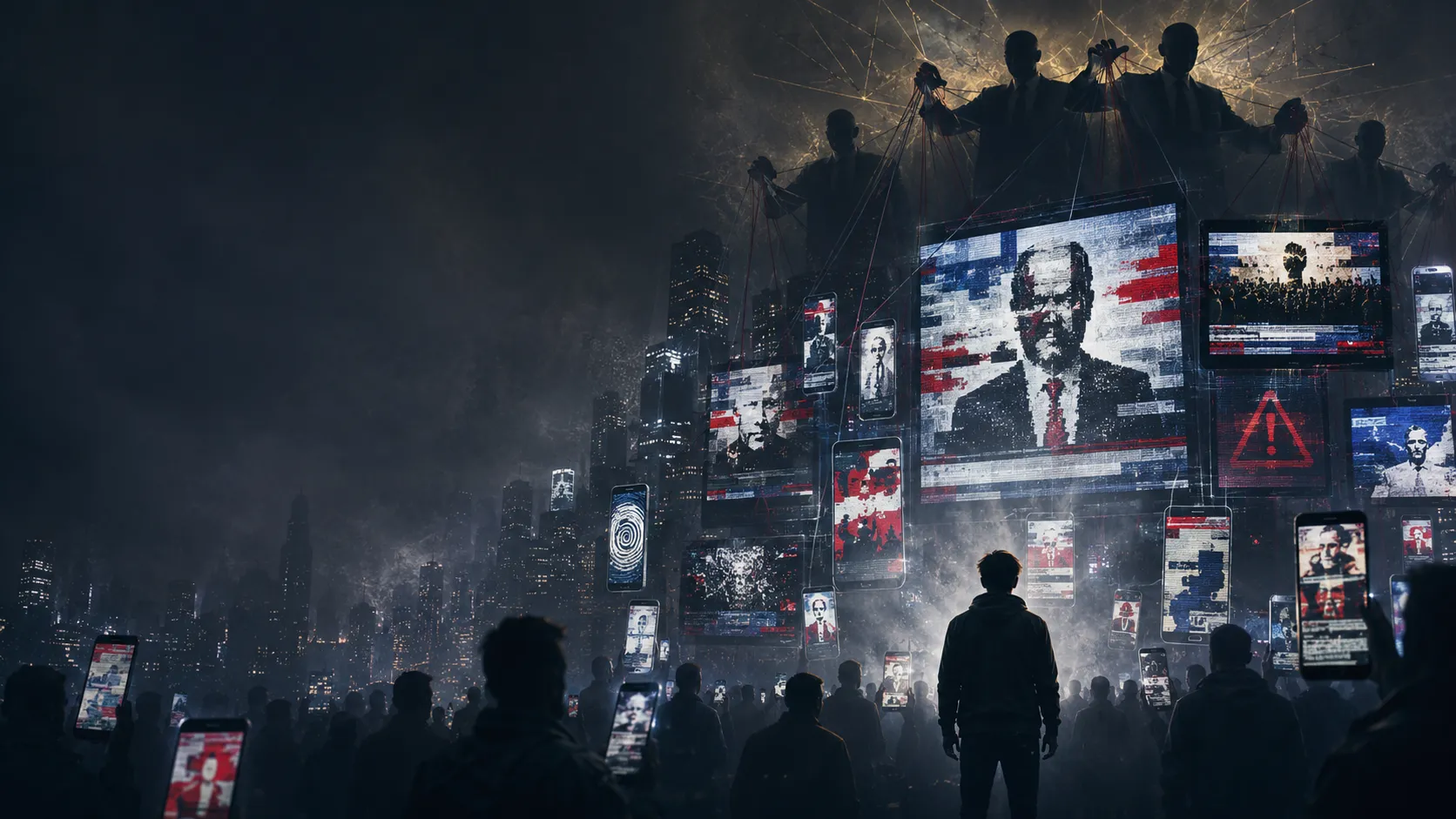
This continuous haze of lies and propaganda is disseminated around the clock to manipulate public opinion and divide American society. Most Americans fail to see the thin line separating their assumptions from the true state of reality. These lies are like the air they breathe, polluted with glittering words, contradictions, and political double-speak. Unscrupulous journalists act as a dead hand on society, keeping the public permanently alarmed with endless imaginary threats.
The underlying reality is that America’s free and open media sources are open only to those who own them. No independent media source truly exists in America. Corporate media figures live by a perverse axiom: logic is an enemy and truth is a menace. They destroy the truth, lie, and fawn over manufactured celebrities to dismantle the country’s moral and ethical foundation from within. They have become the tools and vassals of the American ruling elite.
The Quick Takeaway: Media hypocrisy acts as a premier destabilizing force by dismantling objective reality and replacing it with a manufactured state of false consciousness. This continuous psychological manipulation fractures social cohesion, breeds pervasive cynicism, and pushes the public into a state of legal and cultural anarchy.
The Mechanics of Structural Deception
To understand how media hypocrisy stabilizes elite power, one must analyze how the ruling class uses mass media for control. The system relies on creating a state of false consciousness among the citizenry. By shifting narratives rapidly, the media keeps the public distracted by culture wars while wealth accumulates at the top.
This institutionalized deception is not random; it is highly structured. The media functions as a gatekeeper, filtering out systemic critiques and replacing them with hyper-partisan bickering. This ensures that the foundational structures of the political economy remain unexamined.
The matrix below maps the variables of corporate and political manipulation, showing how this destabilization manifests across different eras.
| Era / Catalyst | Primary Media Narrative | Underlying Systemic Reality | Destabilizing Societal Impact |
| The Liminal 1950s | Universal peace, capitalist prosperity, and idealized nuclear family life. | Strict enforcement of Jim Crow laws, systemic redlining, and intensive Cold War propaganda. | Deep-seated paranoia, the psychological trauma of the Red Scare, and the physical isolation of minority communities. |
| The Civil Rights Era | Frame social justice movements as radical threats or corporate-sanctioned pageantry. | Covert political operations and government reluctance to prosecute systemic racism. | Continued exploitation of black labor, creation of urban ghettos, and deep internal social wounds. |
| The Millennium & Beyond | Hyper-partisan identity politics, corporate wokeism, and manufactured crises. | Unfettered corporate lobbying, massive wealth redistribution to oligarchs, and institutional decay. | Chronic cynicism, the total erosion of critical thinking, and a breakdown of institutional trust. |
The Historical Evolution of Institutional Duplicity
Media hypocrisy did not emerge overnight; it was refined over decades of geopolitical and domestic upheavals. During the post-World War II era, the American media apparatus was weaponized to sell a specific vision of democratic capitalism in direct opposition to Soviet communism. This forced a massive campaign of thought control and regimentation. The media highlighted the benefits of the traditional American lifestyle while completely masking the severe legal and economic disenfranchisement of minorities and women. Television became the primary conduit for these stereotypes and lies, broadcasting demeaning caricatures that rationalized white supremacist violence and Jim Crow segregation.
The Cold War served as the ultimate testing ground for this high coefficient of fiction. Industrial leaders and the military-industrial complex required a basis to rationalize why trillions of dollars were being diverted into weaponry rather than public infrastructure. The media eagerly supplied this pretext by magnifying the threat of the communist whatsit. This psychological manipulation forced families to build fallout shelters and children to practice duck-and-cover drills, embedding a permanent state of trauma into the American collective personality. To dive deeper into how these foundational structures compare, researchers often look at the academic divide between sociology and political science to trace how institutional power shapes human behavior.
When the Soviet Union collapsed, the media apparatus did not dismantle its fear-mongering machine. Instead, it shifted to new targets, proving that the Cold War was an infinite game designed not to be won, but to be perpetuated for profit and control. The media simply replaced old threats with new ones, maintaining the same psychological architecture of anxiety and dependency. This continuous cycle has left lingering social wounds of the Jim Crow era completely unhealed, as the public is systematically encouraged to pick at historical grievances rather than address current systemic corruption.
[Systemic Elite / Oligarchs]
       │
       ▼ (Funds & Controls)
[Media Jackals / Propagandists]
       │
       ▼ (Disseminates Agitprop & False Realities)
[Public Collective Mind] ──► (Result: Paranoid Schizophrenia & Social Anomie)
Identity Politics and the Manufacture of False Reality
In modern America, the corporate press relies heavily on identity politics to fragment the working class. By weaponizing cultural differences, media organizations ensure that horizontal hostility prevents vertical accountability. This strategy is a modern iteration of political gaslighting, where the media fabricates a distorted social milieu to keep the populace from recognizing their shared economic exploitation. The press positions itself as the arbiter of moral truth, yet its programming is explicitly designed to maximize outrage and division.
A clear example of this can be seen in how the media handles corporate social commentary. Network executives champion superficial diversity initiatives on screen while simultaneously masking the economic devastation caused by globalization, gentrification, and deregulation behind the scenes. They preach patriotism and education are traditional American values, while overlaying a media landscape that actively defunds public critical thinking and rewards superficial compliance.
This duplicity creates a profound psychological trap for the consumer. When the media elite uses its platform to scold the public for moral failures, it produces a deep societal cynicism. The public observes the glaring disconnect between the media’s corporate messaging and its actual corporate behavior. This manifests as a pungent odor of hypocrisy that alienates individuals, drives social phobias, and pushes communities into isolated subcultures.
Reclaiming the Public Mind: A Strategy for Inferential Sensemaking
Breaking free from the manufactured corporate narrative requires a deliberate, disciplined approach to processing information. The American individual cannot rely on legacy institutions to provide objective truth. Instead, citizens must develop rigorous internal frameworks for media literacy and independent analysis.
Step 1: Identify the Economic Incentive
Step 2: Strip the Emotional Agitprop
Step 3: Cross-Reference with Baseline Data
Step 4: Execute De-Platforming & Local Realignment
1. Identify the Economic Incentive
Every major news narrative is tied to an underlying financial or political objective. When a specific threat or cultural conflict dominates the airwaves, look directly at who benefits financially from public panic or division. Track the corporate sponsors, parent companies, and lobbying groups tied to the networks broadcasting the information.
2. Strip the Emotional Agitprop
Media organizations use morally charged language, urgent tones, and sensational imagery to bypass critical thinking and trigger primitive emotional responses like fear and anger. To neutralize this, rewrite the core facts of a news story into flat, neutral, emotionless statements. Removing the glittering words allows you to evaluate the actual logic of the claim.
3. Cross-Reference with Baseline Data
Legacy media relies heavily on unverified claims from anonymous official sources or selective data points. Independent strategists must seek out raw, unaggregated data, historical precedents, and alternative international reporting. Do not accept a single source’s interpretation of reality; treat every corporate broadcast as a hypothesis requiring external verification.
4. Execute De-Platforming and Local Realignment
The ultimate tool of the media elite is your attention. Starve the manufactured reality by systematically reducing consumption of corporate network news and algorithmically driven feeds. Redirect that cognitive energy toward localized community organizing, direct economic mutual aid, and face-to-face human interactions that bypass corporate gatekeepers entirely.
Frequently Asked Questions
Media hypocrisy creates anomie by continuously broadcasting conflicting moral standards and outright falsehoods, which completely erodes the public’s understanding of right and wrong. When people realize that institutional leaders and media gatekeepers do not practice what they preach, the foundational social contract unravels. This leaves the public without predictable social relationships or shared norms, resulting in deep cultural alienation and social fragmentation.
What is the role of corporate ownership in driving media bias?
Because independent media sources do not exist in America, corporate media outlets serve strictly as the mouthpieces of the ruling elite who own them. Journalists are forced to operate under the rule that truth is a menace to corporate profit, meaning they must protect elite interests to maintain their employment. The primary goal of these corporate entities is to keep the public locked in a state of false consciousness, distracted by superficial crises while economic exploitation continues unabated.
How do modern media jackals use political gaslighting to manipulate the public?
Media jackals execute political gaslighting and the manufacture of false reality by constantly shifting narratives and presenting highly coordinated propaganda as objective truth. They deliberately create a paranoid milieu in which individuals are forced to doubt their own senses and logical deductions. By manufacturing an endless series of imaginary threats, they keep the populace in a perpetual state of fear, clamoring for state-sanctioned protection.
Rather than facilitating systemic healing, the media deliberately treats historical grievances like a dog with a bone, keeping old societal wounds raw in the public mind. They amplify racial, cultural, and socioeconomic frictions because high-conflict narratives generate massive consumer engagement and ad revenue. This systematic agitation prevents the working class from unifying against the financial and corporate overlords who benefit from horizontal social warfare.
Can independent digital platforms successfully counter legacy media hypocrisy?
While digital platforms offer a theoretical space for decentralized truth, they are highly susceptible to the same corporate forces of algorithmic manipulation, censorship, and elite control. True resistance to the role of media jackals in spreading propaganda requires more than consuming alternative digital content; it demands a fundamental cognitive shift toward critical thinking and local action. The public must move past passive media consumption entirely and actively build independent, community-level networks of information and survival.

0 Comments