


We all know what it feels like to “not fit in.”
Maybe you loved a music style your family hated.
Maybe your friends cared more about climate marches than football games.
Those moments point to something bigger than taste. They point to subcultures and countercultures.
And when you try to describe how subcultures and countercultures are related, the short answer is this. Both groups grow within a larger culture, but one expresses difference, while the other expresses resistance.
Understanding how these two are related helps you make sense of protest movements, culture wars, and even online fandoms. It also helps you see your own levels of awareness and how your values shift over time.
Let’s break it down in plain language.
First, a quick base: what is “culture”?
Culture is a shared “way of life.”
It includes:
- Common values
- Rules about what is “normal”
- Traditions and stories
- Everyday habits like how people dress, talk, eat, and show respect
Every country has a main or dominant culture. Think of it as the “default setting” most people grow up with. But inside that big culture, there are many small ones.
What is a subculture?
A subculture is a smaller group inside the larger culture.
People in a subculture:
- Share the most basic rules with the rest of society
- Follow the same laws
- But have special styles, values, or interests that make them stand out
Examples:
- Skaters, K-pop fans, anime, and cosplay communities
- Goths, punks, hip-hop scenes
- Gamers, car tuners, science-fiction fans
These groups are “different,” but they do not try to tear down the whole system. They still live inside it. They may dress in unique ways, listen to different music, or speak in their own slang, but they are not trying to flip all social rules upside down.
Think of a subculture as a room inside a big house. The house is the wider culture. The room has its own colors and posters, but it is still inside the same building.
What is a counterculture?
A counterculture goes much further.
People in countercultures:
- Reject major values of the dominant culture
- Challenge its power, beliefs, and rules
- Try to build a different way to live
Classic examples:
- 1960s anti-war and hippie movements that opposed war, strict gender roles, and materialism
- Civil rights and Black Power groups that challenged racist laws and white control over public life
- Some radical environmental or political groups that call for big changes to the economy and government
A counterculture is like building a new house across the street because you think the first one is unsafe or unfair.
So how are subcultures and countercultures related?
Even though they look different, they are closely connected.
1. Both live inside the larger culture
Both subcultures and countercultures:
- Grow inside a dominant culture
- Share space, media, schools, and cities with the mainstream
- Form around shared meanings, symbols, and social norms, even if they twist or reject them EBSCO
So they are like branches growing from the same tree. Some branches lean gently to the side. Others push hard in the opposite direction.
2. Both answer to a feeling: “the mainstream is not enough”
People often join these groups because they feel:
- Misunderstood
- Left out of power or resources
- Tired of lies or hypocrisy in public life
Subcultures offer belonging: a place where your music, fashion, or hobby makes sense.
Countercultures offer resistance: a place where your anger at injustice turns into action.
The feeling is the same starting point. The response is different in intensity.
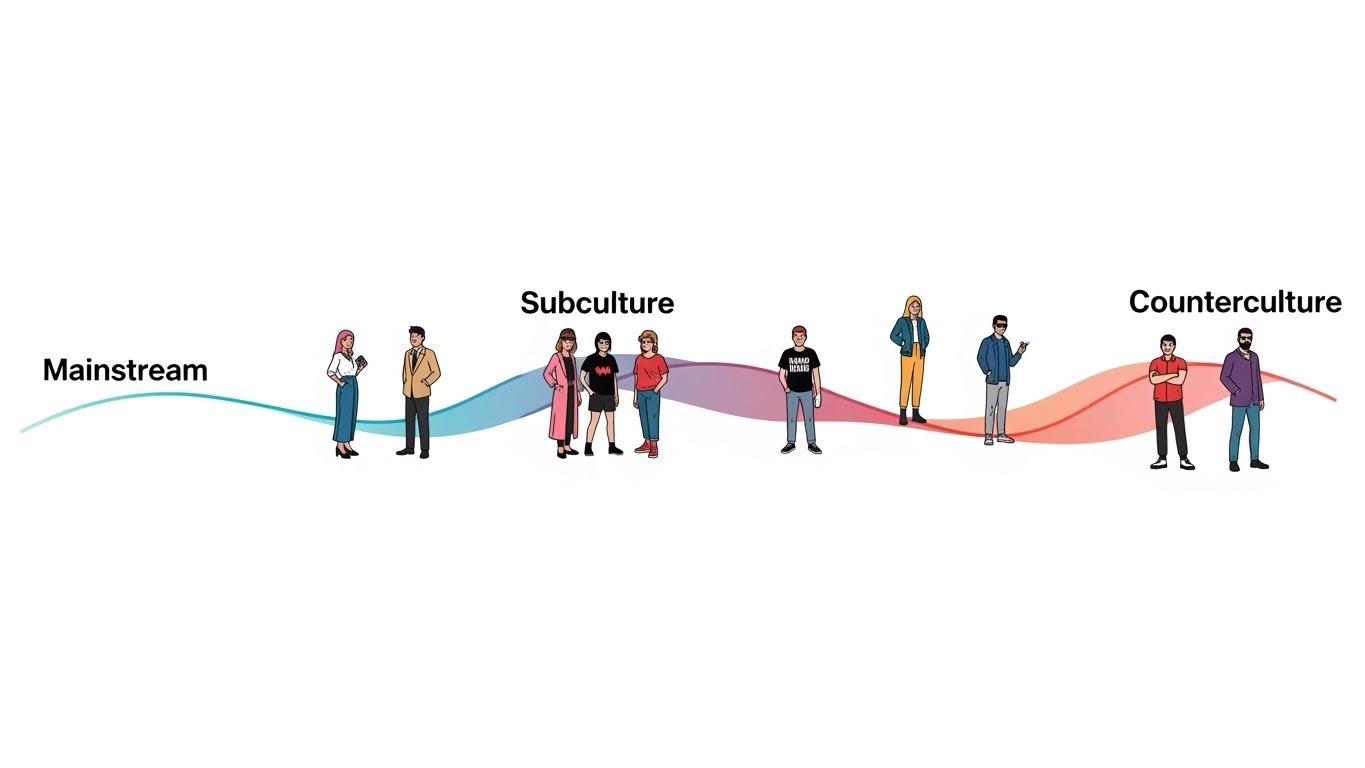
3. They sit on a continuum
You can imagine a line:
Mainstream → Subculture → Strong subculture → Counterculture
Some punk scenes, for example, start as a subculture with special clothes and music. Over time, some groups inside that scene begin to reject big ideas like consumerism, war, or the police. Parts of the subculture slide along the line and become more like a counterculture.
In the 1950s United States, many teens enjoyed new music and styles that annoyed their parents. This youth subculture later fed into the broader 1960s counterculture, which opposed war, racism, and strict family roles.
4. They borrow from each other
Subcultures and countercultures often:
- Share music, visuals, and symbols
- Swap members as people shift their views
- Inspire new “hybrid” groups
A peaceful eco-subculture (people who shop thrift, grow food, and bike everywhere) can inspire a more radical climate counterculture that stages road blockades or mass protests.
At the same time, countercultural ideas like civil rights, women’s rights, or queer pride can later soften into mainstream or subcultural forms, such as diversity clubs at school or corporate Pride events.
When the Mainstream Fights Back: Co-optation and the Cycle of Absorption
Perhaps the most revealing part of the subculture-counterculture relationship is what happens when the dominant culture notices them. Rather than simply opposing alternative groups, mainstream culture has a powerful and well-documented tendency to absorb them — stripping away the resistance while keeping the aesthetic.
This process, called co-optation, follows a recognizable pattern: a subculture develops something authentic, whether a sound, a style, or a set of values; corporations and media notice its appeal; they package and sell it back to the broader public, smoothed of anything genuinely threatening. Punk became a fashion line. Hip-hop became a marketing tool. The counterculture demand for environmental justice became branded reusable shopping bags. What was once an act of resistance becomes a product.
This matters because it explains why many subcultures and countercultures deliberately resist popularity, why some groups guard their symbols and language fiercely, and why members often feel a deep sense of betrayal when their community “goes mainstream.” Understanding co-optation helps you see that the relationship between alternative groups and dominant culture is not just a one-way journey of influence — it is an ongoing negotiation over meaning, identity, and power.
How these groups shape levels of awareness and personal growth
Joining a subculture or counterculture can change human consciousness step by step.
From “fitting in” to “waking up”
You might start in the dominant culture, thinking:
“This is just how things are.”
Then you find a subculture:
“Wow, there are people who think like me.”
This shift raises your self-awareness:
- You notice your own tastes and values
- You see that rules are human-made, not fixed
- You learn to spot social norms instead of just obeying them
If you later move into a counterculture, your awareness levels shift again:
- You start asking, “Who benefits from these rules?”
- You see how fear and ignorance can keep unfair systems in place
- You feel a strong emotional pull to live by your values, even if it costs you comfort
Emotional awareness and identity
These groups can also deepen emotional awareness:
- You feel the pain of injustice more clearly
- You feel joy when you find people who “get” you
- You learn how group pressure shapes choices
This can support personal growth, but it can also lead to burnout or rage if you never rest. Knowing your own limits is part of healthy self-awareness.
Real-life examples of the link between subcultures and countercultures
1. 1950s mainstream and 1960s youth movements
In the 1950s, many Western societies praised a picture of the ideal family: a married couple, two kids, quiet suburbs, and strict gender roles.
Young people began to form subcultures around jazz, rock ’n’ roll, and beat poetry. They tried new clothes and slang, but still lived largely inside the system.
By the 1960s, those same youth networks helped form a counterculture that:
- Opposed the Vietnam War
- Questioned racial segregation
- Challenged traditional ideas about sex, drugs, and religion
A style shift grew into a value shift.
2. Civil rights, Black Power, and cultural conflict
Black communities in the United States built rich subcultures in music, religion, and family life, even under harsh Jim Crow laws. Over time, parts of that cultural life turned into a counterculture that openly fought segregation, police violence, and white political control.
The link here:
- Subcultures gave people strength and a shared identity
- Countercultures turned that strength into mass action and protest
3. Online subcultures today
Today, social media has made it easy for subcultures to form across borders. About 84% of U.S. adults use YouTube, and 71% use Facebook, with half of adults using Instagram. PewResearchCenter Globally, almost 64% of people use some social platform. SmartInsights
That means:
- A teen who loves niche music can find a global fan subculture in minutes
- Gaming, meme, and fandom communities give people shared language and humor
- Some groups slowly turn into countercultural spaces that challenge gender roles, capitalism, or political systems
Again, the pattern is the same: difference first, resistance later.
Why understanding this relationship matters for you
Seeing how subcultures and countercultures connect helps you:
- Read news and history with sharper eyes
- Spot who benefits from certain “normal” rules
- Understand your own journey of personal growth
You might notice that your life has stages:
- Copying what you see around you
- Exploring a subculture that makes you feel at home
- Questioning big systems and maybe joining a counterculture
- Integrating your values into daily life, even when you return to mainstream spaces
Each stage is a step in your self-awareness stages. None of them is “wrong.” The key is to stay honest, kind, and awake, rather than stuck in fear or blind loyalty.
FAQs about subcultures and countercultures
1. Can a group be both a subculture and a counterculture?
Yes. Some groups share hobbies and style like a subculture, but also fight major social rules like a counterculture. For example, a music scene might be mostly about sound and fashion, but a part of it may grow into a political movement.
2. Do countercultures always use protest or violence?
No. Many countercultures use peaceful tools such as boycotts, art, writing, and nonviolent marches. Some do use more direct action, but the key idea is rejection of core mainstream values, not violence itself.
3. What happens when a counterculture “wins”?
If a counterculture’s ideas become widely accepted, they can turn into mainstream values. Equal voting rights for women, for instance, began as a radical demand. Over time, it became common sense in many countries.
4. Are online fandoms and gaming groups subcultures?
Yes, they usually are. They have their own slang, jokes, and shared stories. A few corners of these spaces may turn countercultural if they start pushing strong political or social resistance.
5. How can I tell if I am in a healthy group?
Ask yourself:
- Does this group respect my choices and safety?
- Am I allowed to question leaders or ideas?
- Do I feel more alive, kind, and aware, or more hateful and closed?
Healthy subcultures and countercultures support growth, not abuse.
Your next step
Take a moment and think:
- Which subcultures have shaped you so far?
- Have you ever felt pulled toward a counterculture?
- How did those groups change your awareness and values?
If this article helped you see your own journey more clearly, save it, share it with a friend, or leave a comment with an example from your life. Your story might help someone else understand their own path from “fitting in” to “waking up.”

0 Comments