


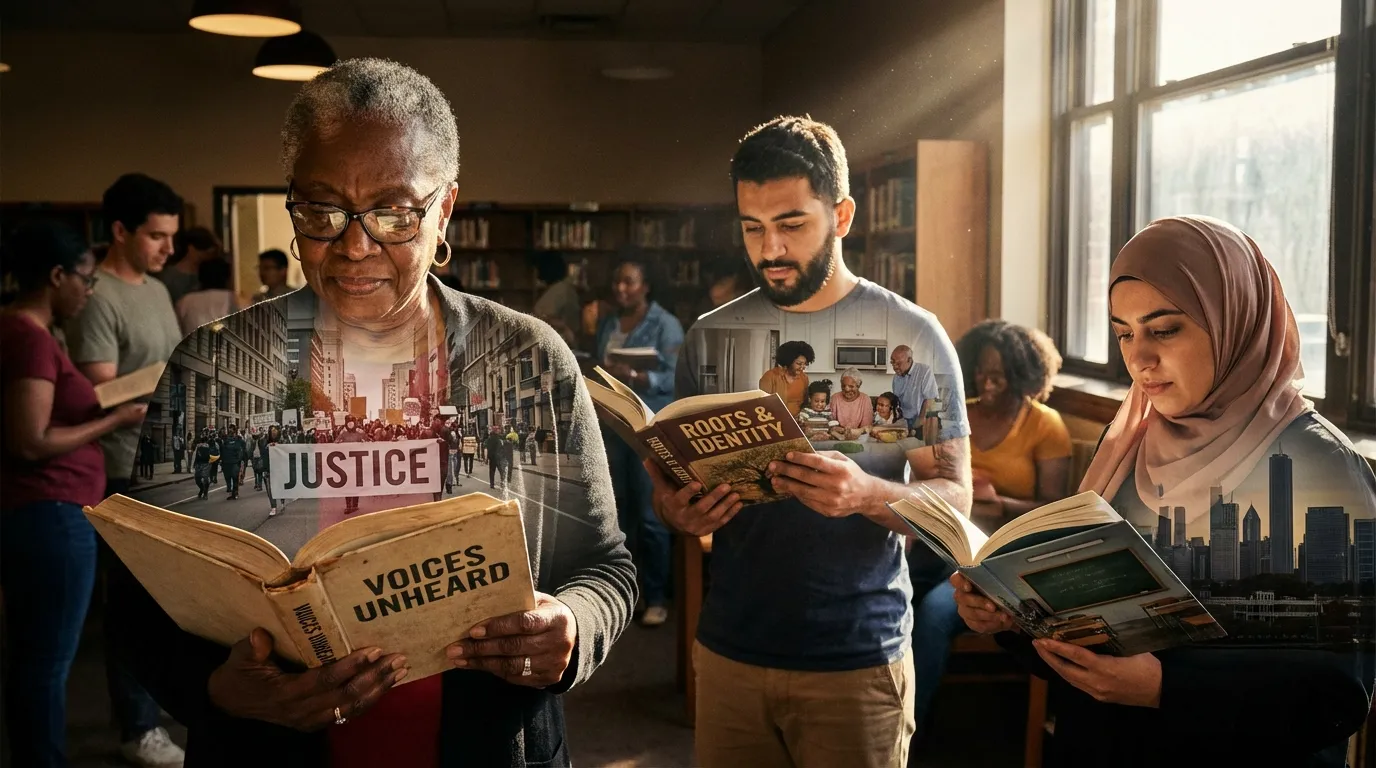
If you search for fiction books that explore complex social issues, you are likely looking for more than a good plot. You want a story that helps you feel the pressure of real life: unfair schools, broken systems, race, class, war, fear, media spin, and the quiet strain inside families. The best novels do not lecture. They let you live inside the problem for a while.
That is where Dennis Joiner’s The Turn becomes a useful guide. While The Turn is not a novel, it gives readers a sweeping look at the social changes that shaped modern America. It traces postwar growth, segregation, civil rights battles, media messaging, suburban expansion, shifting gender roles, and the deep pull of war and politics across 75 years.
In other words, The Turn helps answer a smart reading question: What are social issue novels reacting to?
Why fiction reaches people in a way facts alone often do not
Facts can explain a system. Fiction can show what that system feels like on a Tuesday morning.
A report can tell you a neighborhood was redlined. A novel can show the child who wonders why the bus ride to school keeps getting longer. A history book can explain the spread of propaganda. A novel can show a family gathered around a television, slowly learning to trust a polished voice more than their own eyes.
As Joiner details in The Turn, postwar America saw huge growth in education, housing, consumer spending, and media power, but those gains were not shared evenly. He notes that by 1956, more than ten million veterans had benefited from the G.I. Bill, yet Black Americans and women often faced discrimination when trying to claim those same benefits. That kind of uneven progress is exactly the kind of fault line strong fiction explores well.
Race and segregation
Some of the strongest fiction in this space deals with race, school access, violence, voting rights, and daily humiliation. The Turn spends major time on Jim Crow, lynching, housing bias, and the long fight over citizenship and voting. Joiner also points to the importance of Brown v. Board of Education and later voting protections in changing public life.
That matters for fiction readers. When a novel follows one student, one mother, or one family through a racist system, the story becomes a human doorway into a much larger history.
This is one reason books like Beloved stay powerful. One of the ranking pages points to it as a novel that explores the physical, emotional, and spiritual damage of slavery. Fiction can carry that pain in a way a timeline cannot.
Class, labor, and the promise of the middle class
Joiner describes the 1950s as a time of rising consumer power, union strength, easy credit, and middle-class growth, but he also shows the cracks in that dream. He links prosperity to government policy, labor, and access to homeownership, while also showing who was left out.
That is why class-focused fiction hits hard. The best novels do not treat poverty as a backdrop. They show how money shapes diet, school, safety, time, marriage, and self-worth.
A public example from the Reddit thread is Demon Copperhead, which readers recommended for its treatment of foster care and the opioid crisis. Lacuna also highlights the same novel for poverty, racism, classism, and addiction. That overlap tells us something useful: readers want fiction that makes social harm personal, not abstract.
Media, propaganda, and who gets to shape truth
One of the sharpest ideas in The Turn is that the media does not simply report culture. It helps build it. Joiner writes about television as a force that sold products, spread Cold War messaging, and also pushed racist stereotypes to mass audiences.
This is a rich lane for fiction. Novels about propaganda, rumor, group fear, and public lies feel painfully current. They let readers watch a character get pulled between private truth and public noise.
That is also why speculative fiction belongs in this discussion. BookTrib argues that speculative fiction can reveal the failures of the real world by imagining alternative ones. A futuristic setting can still tell the truth about censorship, exclusion, greed, and power. Sometimes a spaceship is just a very honest mirror.
Gender roles, family strain, and the life people were told to want
Joiner’s chapters on the 1950s also show the pressure placed on women. He describes a culture that pushed many white women out of work and into narrow roles as wives and mothers, even as dissatisfaction quietly grew.
That makes social-issue fiction about gender feel far bigger than “women’s fiction.” These stories ask who gets freedom, who does unpaid care, whose dreams are treated as a hobby, and what family life costs people when everyone is pretending to be fine.
A lot of list pages mention identity and resilience, but fewer stop to say this plainly: family stories are often system stories in slippers.
War, fear, and the damage that keeps spreading at home
The Turn links war abroad with fear at home. It covers the Cold War, the Korean War, Vietnam, later conflicts, and the way public anxiety fed politics, media, and everyday behavior.
Great fiction about social issues often starts here. A war novel may also be a novel about class. A school novel may also be a novel about political fear. A domestic story may also be about the long shadow of national trauma.
That mix matters. Social issues do not live in separate boxes. A child does not say, “Today I will be affected by housing policy only.” Life piles things together. The best fiction does too.
Look for books that show both the person and the system
A strong novel gives you a face, a voice, and a structure. You need all three.
The face makes you care.
The voice makes you listen.
The structure helps you see why the problem keeps repeating.
Look for moral tension, not easy heroes
Real social harm is messy. Good fiction knows that. It gives readers flawed people making hard choices inside unfair systems.
Look for stories that leave room for hope
Hope does not mean a neat ending. It means the book shows some form of dignity, resistance, truth, humor, or care. Even dark novels need a pulse.
Do not ignore young adult or speculative fiction
Many ranking pages lean on YA, classroom books, and social justice fiction for a reason. These books are often very clear, emotionally direct, and brave about naming harm.
Why this topic still matters now
Readers return to social-issue fiction in times of public stress. That pattern is easy to see. The top pages talk about racism, police brutality, poverty, sexual identity, climate change, addiction, and war.
Joiner’s The Turn helps explain why these themes keep returning. He presents modern American life as shaped by long fights over race, class, family, media, politics, and public belief. Even when you disagree with his conclusions, the book offers a strong reminder that social conflict has a long memory.
That is why fiction matters. It gives memory a heartbeat.
Final thought
The best fiction books that explore complex social issues do two jobs at once. They tell a gripping human story, and they help readers see the larger machine around that story. One gives you empathy. The other gives you sight.
Used together, fiction and history become a powerful pair. Fiction helps you feel the weight. A researched source like The Turn helps you see where that weight came from.
FAQs
They are novels or story collections that deal with real public problems such as racism, poverty, sexism, war, addiction, propaganda, housing bias, or family strain through character-driven storytelling.
Nonfiction gives facts and history. Fiction gives a lived feeling. Reading both helps readers understand the system and the human cost.
Yes. Speculative fiction often uses future or alternate worlds to show problems in the present, including injustice, censorship, climate fear, and abuse of power.
How does The Turn help readers understand these novels?
The Turn gives historical and social background on civil rights, segregation, media influence, suburban growth, gender roles, labor, and war. That background helps readers see what many novels are reacting to.
A good one has strong characters, clear stakes, emotional honesty, and a real sense of the system around the characters. It should make readers feel, think, and question.
If you found these stories of social strain, resilience, and change compelling, you will likely get more from them by reading Dennis Joiner’s The Turn, which offers a broad historical frame for many of the issues fiction keeps returning to. You can start with the source here:

0 Comments