


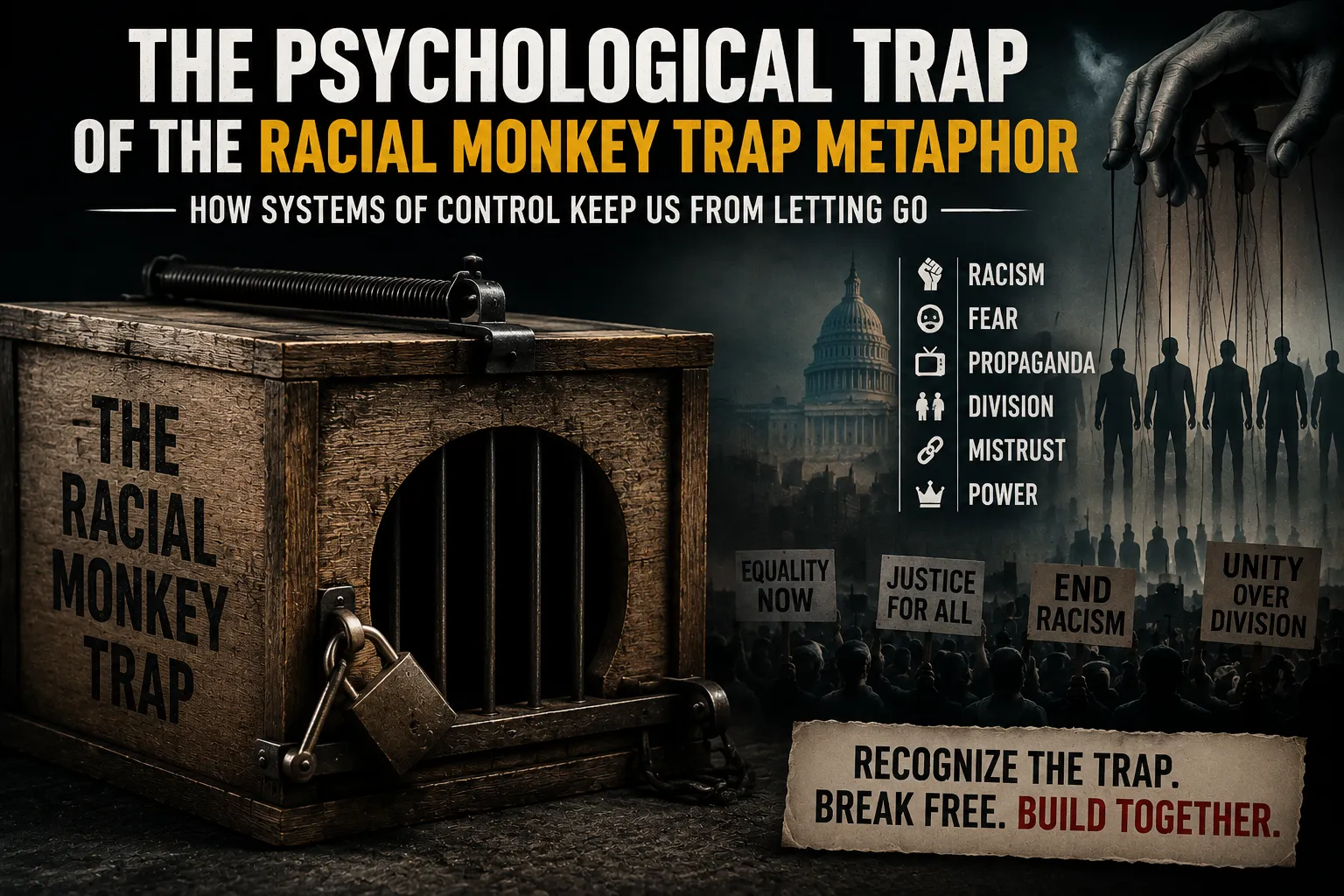
For too many people, the idea of race has become a snare rather than a lens for understanding human experience. Individuals and communities hang on to racial identity as if letting go meant erasing history or diminishing suffering, even when that fixation limits personal growth, harms relationships, and blocks collaborative solutions. This cognitive loop traps thinking in cycles of grievance and reaction, setting up psychological barriers that persist long after explicit legal barriers have fallen.
Recognizing this pattern matters because the deeper problem is not simply that people notice race, but that the emotional meaning invested in racial categories creates a subtle yet powerful psychological bind. That bind explains why conversations about equality often become polarized, why solutions stall, and why individuals feel stuck in patterns of fear or anger that diminish agency and well-being.
The Quick Takeaway: The psychological trap of the racial monkey trap metaphor is the way that clinging to race as an anchor for identity, threat, or entitlement perpetuates mental and social limitation. True advancement requires seeing how that psychological grip distorts perception and making a conscious choice to release it.
Core Comparison Matrix
| Aspect of Experience | Holding On to Race | Releasing the Trap | Observable Outcome |
|---|---|---|---|
| Internal Psychology | Self-limiting narratives, anxiety, resentment | Clarity, self-direction, reduced fear | Greater emotional regulation |
| Interpersonal Relations | Suspicion, defensive fields, stereotype anticipation | Empathy, curiosity, individualized engagement | More agreements, fewer misreadings |
| Cultural Representation | Reinforced caricatures, monolithic group thinking | Diverse, nuanced self-expression | Richer cultural dialogue |
| Societal Structures | Policy by reaction to historic wounds | Policy by need and evidence | Equitable systems that address real disparities |
| Political Dynamics | Identity politics exploitation | Issue-focused civic interaction | Reduced polarization and tribal conflict |
What the Racial Monkey Trap Metaphor Explains
The Psychological Dynamics of Gripping Racial Identity
The racial monkey trap metaphor imagines a situation where a monkey reaches for a treat inside a container that is too small for its clenched fist to withdraw. The monkey will not let go, even as the trap closes around it, because it equates release with loss. Similarly, when people treat racial identity as something fixed, defining, or protective, they may resist letting go of its psychological grip even when it limits freedom.
In this frame, the trap is not simply about race itself. Race becomes meaningful because societies invest it with emotional weight, historical grievance, and social consequence. Those investments create a feedback loop: people learn that holding on brings attention, moral praise, or political leverage, which reinforces the very fixation that limits clear perception and agency.
At the psychological level, this shows up as a pattern of threat anticipation, emotional reactivity, and cognitive narrowing. When someone is constantly interpreting situations through a racial lens of harm or validation, they are less able to see nuance or to distinguish immediate reality from projected fears or historical patterns.
This dynamic directly affects how people relate, how they interpret everyday interactions, and how they make decisions. It constrains thinking in ways that can look almost involuntary because the associations between race and danger, entitlement, or victimhood become conditioned.
Historical Roots and Persistent Patterns
The metaphor takes on special force in the context of post-Civil Rights American history. Legal barriers like segregation and disenfranchisement were dismantled, but the psychological and social structures that gave race its emotional force did not simply disappear. Decades of policy, migration patterns, residential segregation, labor market segmentation, and educational inequality maintained real-world differences that kept racial identity salient.
Even when laws changed, cultural narratives about threat and competition remained. Media patterns reified stereotypes of both Black and White Americans in ways that reinforced social distance rather than bridging it. Educational systems seldom taught the complexity of systemic forces, encouraging simplified group thinking instead.
These historical configurations help explain why the racial monkey trap persists: it is embedded not in a single law or institution but in repeated patterns of interpretation, response, and meaning-making that persist across generations. As societies invest emotional resources into these categories, they inadvertently strengthen the very patterns that keep people psychologically stuck.
Contemporary Manifestations in Everyday Life
In modern social settings, the trap shows up in predictable ways. A manager might assume the behavior of a colleague reflects group stereotype rather than individual personality. A community conversation about policing may become polarized because each side assumes malicious intent from “the other.” In such moments, race functions less as a descriptor of experience and more as a cognitive shortcut for threat, identity, or expectation.
Social media amplifies these tendencies. Algorithms favor emotionally charged content, which often means racial grievance, outrage, or affirmation cycles get repeated and reinforced. As a result, millions of users encounter patterns of discourse that make the psychological trap feel normal and inevitable.
When people internalize narratives that cast interactions in racial categories, they make sense of actions through a lens of fixed group identity. That makes cooperative problem-solving harder because discussions start from assumptions about motive rather than observation of specific behavior.
How the Trap Interacts With Broader Social Forces
Racial Identity and Individualism
American cultural psychology emphasizes individual agency and self-definition, but when this interacts with race-focused narratives, it complicates how people see themselves. Some define success or failure in ways entangled with group history, and others interpret criticism as an attack on identity rather than an invitation to growth.
At the same time, perceptions of group entitlement or defense can reinforce group boundaries and distance. That dynamic undermines the capacity for people to see each other first as individuals with unique aspirations and challenges rather than representatives of monolithic social categories.
Understanding the role that individualism plays in American society provides insight into how these intersecting pressures shape behavior. It highlights the tension between self-driven growth and collective meaning-making that amplifies group boundaries.
Media, Narrative Framing, and Expectation
Where people get information matters. Media outlets often frame events in ways that heighten conflict between racial communities because controversy draws more attention. Those frames become habits of interpretation, shaping how audiences read events, misread intentions, and anticipate hostilities.
This is one reason why the trap replicates itself: emotional narratives about race are vivid, repeatable, and socially rewarded. When someone gains attention or validation by interpreting events through a racial conflict lens, they reinforce the psychological loop.
Understanding how social messaging shapes perception connects with ideas about social conditioning. Repeated exposure to simplified racial narratives conditions expectations, which then reinforce the very divisions the narratives describe.
Policy, Perception, and Practical Outcomes
When policymakers assume that racial categories inherently explain behavior or need special protection in the absence of better metrics, they can inadvertently lock communities into patterns of dependency or entitlement thinking. This raises questions about how social justice is conceptualized and practiced.
Balancing genuine efforts to correct inequities with a commitment to individual agency and evidence-based policy requires rethinking how race is conceptualized. That rethinking can begin by recognizing the trap: that clinging to race as a primary causal factor obscures deeper forces like class, opportunity structure, and culture.
Step-by-Step Guide to Escaping the Trap
- Identify Patterns of Reactive Thinking
Notice when your interpretation of actions is driven by assumptions about group identity rather than specific context. Track emotional spikes tied to group narratives. - Contextualize Historical Differences With Structural Awareness
Consider historic inequities without treating them as fixed explanations for present behavior. Use nuanced frameworks that link systemic patterns with present-day experience, such as those described in lingering social wounds of the Jim Crow era. - Encourage Personal Narrative Over Group Category
In conversations, ask people to describe their individual experiences rather than defaulting to group labels. This shifts focus from stereotype anticipation to actual motivations. - Balance Narrative With Evidence
When evaluating social issues, anchor discussions in empirical data—education outcomes, economic metrics, and behavioral research—rather than solely emotional narratives. - Practice Emotional Regulation
Learn to separate the instinctive emotional charge around race from your cognitive assessment. Meditation, reflective journaling, or conversational practice helps disentangle affect from interpretation. - Invest in Mixed-Context Interaction
Build relationships with people outside of familiar group boundaries to challenge preconceptions and broaden perspective. Familiarity reduces stereotype-based expectations. - Reflect and Adjust Habitual Responses
After interactions, revisit how you interpreted others’ motives and consider alternative explanations free from group-based assumptions.
Each of these steps operates at the psychological level while also reshaping social perception and behavior. They form a sequence that moves from introspection to outward practice, reinforcing both individual agency and healthier social engagement.
Real-World Examples
In the workplace, a leader who suspects motive based on race may misinterpret feedback, causing conflict that has little to do with racial intent. By reframing conclusions around specific behavior, the leader avoids unnecessary defensiveness and opens space for productive dialogue.
In educational settings, teachers who expect certain performance patterns from racial groups may unconsciously influence how they allocate attention. Shifting focus to individual strengths rather than group averages improves engagement and outcomes.
In community discussion boards, moderators who allow emotionally charged racial narratives to dominate conversations inadvertently reinforce the trap. Encouraging context-specific discussion, grounded in observable facts rather than emotion-based accusation, improves tone and cooperation.
Further Contextual Reading
Explore sociological distinctions that clarify how identity categories shape behavior in comparison with political systems: Sociology vs. Political Science. Policy debates about justice frameworks illuminate how social and economic aims shift depending on framing: Market Justice vs. Social Justice Explained. For insight into broader narrative manipulation in public life, see political gaslighting and ethical scrutiny of partisan behavior in the odor of hypocrisy in politics.
FAQ
How does the racial monkey trap differ from normal awareness of race?
Normal awareness acknowledges that race can influence experience without making it the primary lens for interpreting every interaction. The psychological trap happens when race becomes a default frame that eclipses specific context and individual agency.
Why do people resist letting go of racial fixation if it causes harm?
Emotional meaning and social reinforcement make the fixation feel valuable or protective. That reinforcement comes through social validation, political leverage, or identity affirmation, which can make grasping the trap feel safer than releasing it.
Can recognizing racial patterns still be useful without falling into the trap?
Yes. Recognizing historical and structural differences is essential for equity. The trap lies in letting those categories dictate instinctive interpretation rather than serving as one factor among many in thoughtful analysis.
How can organizations reduce the impact of this psychological trap?
By prioritizing individual data and behavior over group assumptions, encouraging reflective practices, and grounding policy choices in evidence rather than narrative reaction. This builds stronger, more inclusive systems.
Do all communities experience the trap in the same way?
No. The psychological grip varies by history, social structure, media environment, and personal experience. Appreciating these variations helps tailor approaches that honor history without reinforcing limitations.

0 Comments